Breast Cancer: Symptoms, Causes, Types, and Treatment in India
By MightyHealth
147 Views
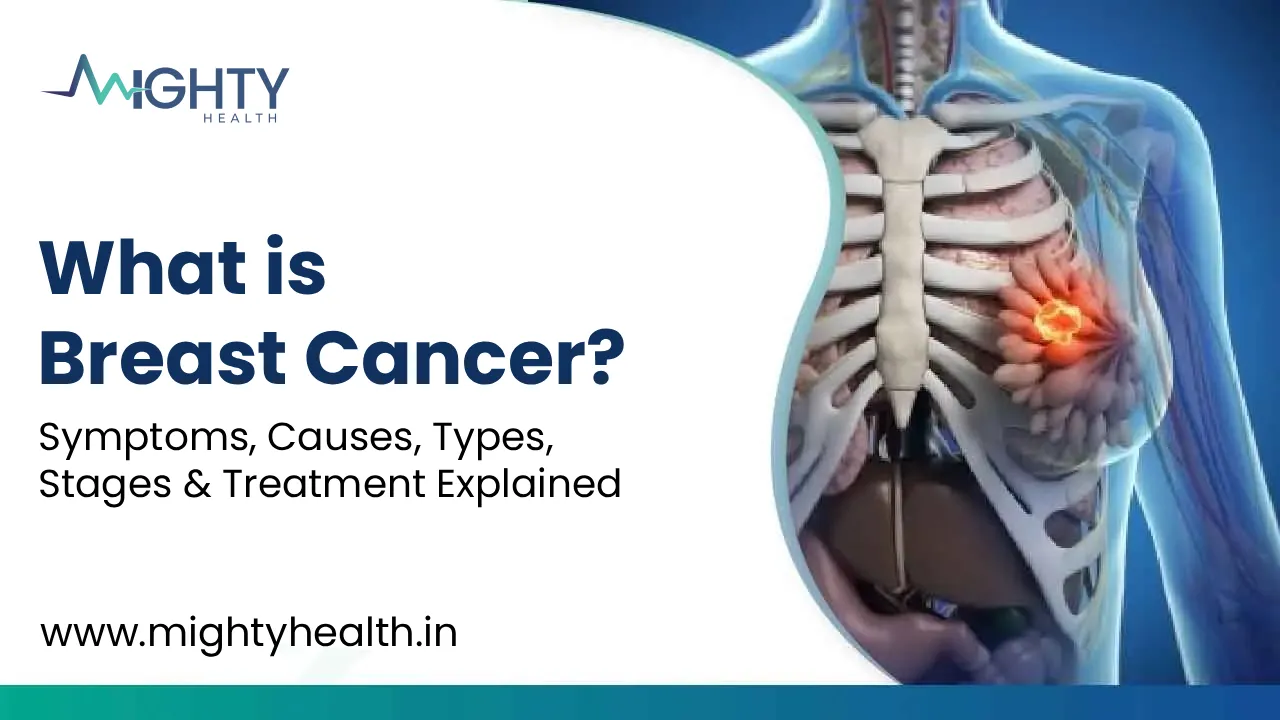
Breast cancer is one of those topics that deserves more honest conversation and less fear-driven silence. It is not just a women's issue. It is not a death sentence. And it is absolutely not something you should Google at 2 AM without some solid, trusted information to guide you.
This article covers everything you need to know about the early signs of breast cancer, to treatment options available in India. Backed by data from the WHO, American Cancer Society, and National Cancer Institute.
Let's break it down clearly.
What Is Breast Cancer?
Breast cancer is a disease where abnormal cells in the breast grow uncontrollably and form tumours. According to the World Health Organization (WHO), breast cancer cells typically begin inside the milk ducts or milk-producing lobules of the breast. If left unchecked, these cells can invade nearby tissue and eventually spread to other parts of the body.
Here is the part that surprises most people: approximately 80% of breast cancers occur in women with no specific risk factors other than their sex and age. That means you do not need a family history or a "risky" lifestyle to develop it. It can simply happen.
Globally, breast cancer is now the most commonly diagnosed cancer in the world, with an estimated 2.26 million new cases recorded in 2020 alone, according to a study published in the British Journal of Radiology.
Early Signs of Breast Cancer You Should Never Ignore
Catching breast cancer early can be life-changing. The 5-year survival rate for breast cancer detected at its earliest, localised stage is over 99%, according to the National Breast Cancer Foundation.
So what should you look out for? Here are the most common early signs of breast cancer:
- A lump or thickening in the breast or underarm area
- Unexplained change in breast size or shape
- Skin dimpling or puckering (it can look like an orange peel)
- Nipple discharge that is not breast milk
- Redness, scaling, or flaking of the nipple or breast skin
- Nipple pulling inward (inversion)
- Persistent breast pain that does not go away with your menstrual cycle
One important thing to note: not every lump is cancer. Most lumps are benign (non-cancerous). But any lump that is new, persistent, or unusual needs a doctor's evaluation. No excuses, no delays.
Up to 15% of women are diagnosed with breast cancer through a breast mass that is not visible on a mammogram, according to Dr. Aaron Gilson, a plastic and reconstructive surgeon cited by SingleCare. This is why self-examinations and clinical checkups matter alongside regular screening.
Breast Cancer Symptoms: What the Body Is Telling You
Breast cancer symptoms can be subtle at first, which is exactly what makes them dangerous if ignored. Beyond the classic lump, watch for:
- Swelling in part or all of the breast (even with no lump)
- Warmth or redness across the breast skin
- A visible vein pattern that appears suddenly
- Breast skin that looks thicker than usual
- Pain or tenderness that stays in one spot
Not all of these symptoms will appear together. Some women experience none at all until a routine mammogram flags something unusual. That is precisely why routine screening exists, because your body does not always send obvious signals.
What Causes Breast Cancer?
There is no single cause of breast cancer. It develops from a combination of genetic, hormonal, and lifestyle-related factors. Here is what the research tells us:
Factors you cannot control:
- Being female (the biggest single risk factor)
- Getting older (median age at diagnosis is 62 years, per the National Cancer Institute)
- A woman's risk nearly doubles if a first-degree relative (mother, sister, or daughter) has had breast cancer
- Inherited gene mutations, particularly BRCA1 and BRCA2
- Dense breast tissue
Factors that may increase risk:
- Hormone replacement therapy (HRT) with estrogen or progesterone
- Alcohol consumption
- Obesity, particularly after menopause
- Lack of physical activity
- Starting periods early (before age 12) or menopause late (after age 55)
Understanding causes of breast cancer helps in two ways: knowing your risk level and making informed lifestyle choices where possible. You cannot change your genes, but you can manage the factors that are within your control.
Types of Breast Cancer
Not all breast cancers are the same. Different types of breast cancer behave differently and require different treatments. Here are the main ones:
Invasive Ductal Carcinoma (IDC): The most common type. It starts in the milk ducts and invades surrounding breast tissue. It accounts for roughly 70–80% of all breast cancer diagnoses.
Invasive Lobular Carcinoma (ILC): Originates in the milk-producing lobules and spreads to surrounding tissue. It can be harder to detect on mammograms.
Ductal Carcinoma In Situ (DCIS): A non-invasive, early-stage cancer where abnormal cells are contained within the milk ducts and have not spread. Highly treatable.
Triple-Negative Breast Cancer (TNBC) : This type lacks three common receptors (estrogen, progesterone, and HER2), making it harder to treat with hormone therapy. It is more aggressive but responds well to chemotherapy.
HER2-Positive Breast Cancer: Overexpresses the HER2 protein, driving faster cancer growth. Targeted therapies like trastuzumab (Herceptin) have transformed outcomes for this type.
Inflammatory Breast Cancer (IBC): Rare but aggressive. It causes the breast to appear red, swollen, and inflamed. It often has no distinct lump, making it easy to miss.
Stage 3 Breast Cancer: What It Means
Stage 3 breast cancer: also called Locally Advanced Breast Cancer (LABC) means the cancer has spread beyond the primary tumour into the surrounding architecture of the breast, such as the chest wall, skin, or nearby lymph nodes. It has not yet reached distant organs like the liver or brain (that would be Stage 4).
Stage 3 is divided into three sub-stages:
- Stage 3A: Tumour larger than 5cm with spread to 1–3 lymph nodes, or any size tumour with spread to 4–9 lymph nodes
- Stage 3B: Cancer has grown into the chest wall or breast skin and may affect nearby lymph nodes
- Stage 3C: Cancer has spread to 10 or more lymph nodes or those near the collarbone
The good news? According to the American Cancer Society, the 5-year survival rate for Stage 3 breast cancer is 87%. This is not a number to despair over; it is a number to act on. Survival rates have improved significantly over the past decade thanks to better therapies and earlier interventions.
Breast Cancer Treatment in India
India has emerged as a serious destination for quality breast cancer care at a fraction of the cost of Western countries. Whether you are a resident or an international patient seeking affordable, world-class oncology, breast cancer treatment in India offers a strong combination of medical expertise and cost-effectiveness.
Treatment Options
Treatment for breast cancer typically combines several approaches depending on the stage, type, and individual health profile:
Surgery: Options include lumpectomy (removing only the tumour) or mastectomy (removing the entire breast). In India, surgical costs range from approximately ₹1.5 lakh to ₹5 lakh, depending on the procedure and hospital.
Chemotherapy: Drugs that target fast-growing cancer cells throughout the body. Most patients require 6–8 cycles. Per-cycle costs in India typically fall between ₹20,000 and ₹1,00,000, depending on the drug protocol.
Radiation Therapy: Used after surgery to destroy remaining cancer cells in the area. A complete course of radiation in India generally costs between ₹1 lakh and ₹5 lakh.
Targeted Therapy: For HER2-positive cancers, drugs like trastuzumab (Herceptin) directly attack cancer proteins with fewer side effects than chemotherapy. Costs can reach ₹75,000 to ₹2 lakh per cycle.
Hormone Therapy: Used for hormone receptor-positive cancers. Drugs like tamoxifen or aromatase inhibitors block the estrogen signals that fuel cancer growth. Monthly costs range from ₹2,000 to ₹10,000.
Immunotherapy: Increasingly available in India for specific breast cancer types, particularly Triple-Negative. Costs vary widely but can exceed ₹25 lakh for advanced-stage treatment.
According to HCG Oncology, the overall average breast cancer treatment cost in India is approximately ₹7,00,000, though advanced stages can push this to ₹16 lakh or beyond. Compared to similar treatment in the US or UAE, Indian costs are often one-fifth or less — without compromising on quality at leading cancer centres.
Final Thoughts
Breast cancer is serious. But it is also one of the most researched, most treated, and when caught early, most survivable cancers in the world. The conversation about it should happen in homes, clinics, workplaces, and online, openly and without shame.
Frequently Asked Questions (FAQs)
What is breast cancer?
Breast cancer is a condition where cells in the breast grow abnormally and out of control, forming a tumour. These cells typically originate in the milk ducts or lobules of the breast. If not treated, the cancer can invade surrounding tissue and spread to other organs through the lymphatic system or bloodstream.
What is the main cause of breast cancer?
There is no single main cause. Breast cancer develops from a mix of genetic mutations, hormonal influences, and environmental factors. Being female and getting older are the two most significant risk factors. Inherited mutations in the BRCA1 or BRCA2 genes also significantly elevate risk, though they account for a minority of all cases.
What are 5 signs of breast cancer?
The five most common warning signs are:
1. A new lump or hard mass in the breast or armpit
2. Unexplained change in breast size, shape, or appearance
3. Skin changes such as dimpling, puckering, or thickening
4. Nipple discharge (other than breast milk) or nipple inversion
5. Persistent redness or warmth in the breast skin
How to identify breast cancer?
Breast cancer is identified through a combination of self-examination, clinical breast exams, and diagnostic imaging. Mammography is the gold-standard screening tool. If a suspicious area is found, an ultrasound or MRI may follow, and a biopsy (taking a small tissue sample) is the only way to confirm a cancer diagnosis with certainty.
How to check for breast cancer?
Start with a monthly breast self-exam — look and feel for any new lumps, changes in skin texture, nipple changes, or unusual pain. Beyond self-checks, women over 40 (or younger with risk factors) should get annual mammograms. Women in India with a family history of breast cancer should discuss earlier, more frequent screening with their doctor.
How to prevent breast cancer?
No method offers 100% prevention, but the following steps can meaningfully reduce risk, according to the American Cancer Society:
- Maintain a healthy body weight, especially after menopause
- Exercise regularly (at least 150 minutes of moderate activity per week)
- Limit or avoid alcohol
- Breastfeed if possible (shown to lower risk)
- Avoid or limit long-term hormone replacement therapy
- Get regular screenings for early detection — which is the closest thing to prevention that exists
Can males have breast cancer?
Yes. Men have breast tissue too, and they can develop breast cancer. According to the CDC, approximately 1 in 100 breast cancer diagnoses in the US occurs in men. The WHO estimates that 0.5–1% of all breast cancers globally affect men. It is rarer, but it happens — and male breast cancer is often caught later because neither men nor their doctors tend to think of it first.
What happens after breast cancer?
After completing treatment, patients enter a monitoring phase. This includes regular follow-up appointments, imaging, and blood tests to check for recurrence. Many survivors need ongoing hormone therapy for 5–10 years. Life after breast cancer also involves emotional recovery, physical rehabilitation (especially after surgery), and sometimes breast reconstruction. Support groups, therapy, and lifestyle adjustments all play a role in long-term wellbeing.
Is stage 4 cancer 100% death?
No. Stage 4 breast cancer — where the cancer has spread to distant organs — is considered advanced and is not curable in most cases. However, it is treatable. Many patients live for years with Stage 4 disease, managing it as a chronic condition through ongoing therapy. According to NCI data, the 5-year survival rate for distant-stage (Stage 4) breast cancer is approximately 31.9%. Advances in targeted therapy and immunotherapy continue to improve these outcomes. It is not a guaranteed death sentence, but it does require immediate, aggressive, and sustained medical care.