KYC Verification Platform in India – One API for All Verifications
By Roopya
179 Views
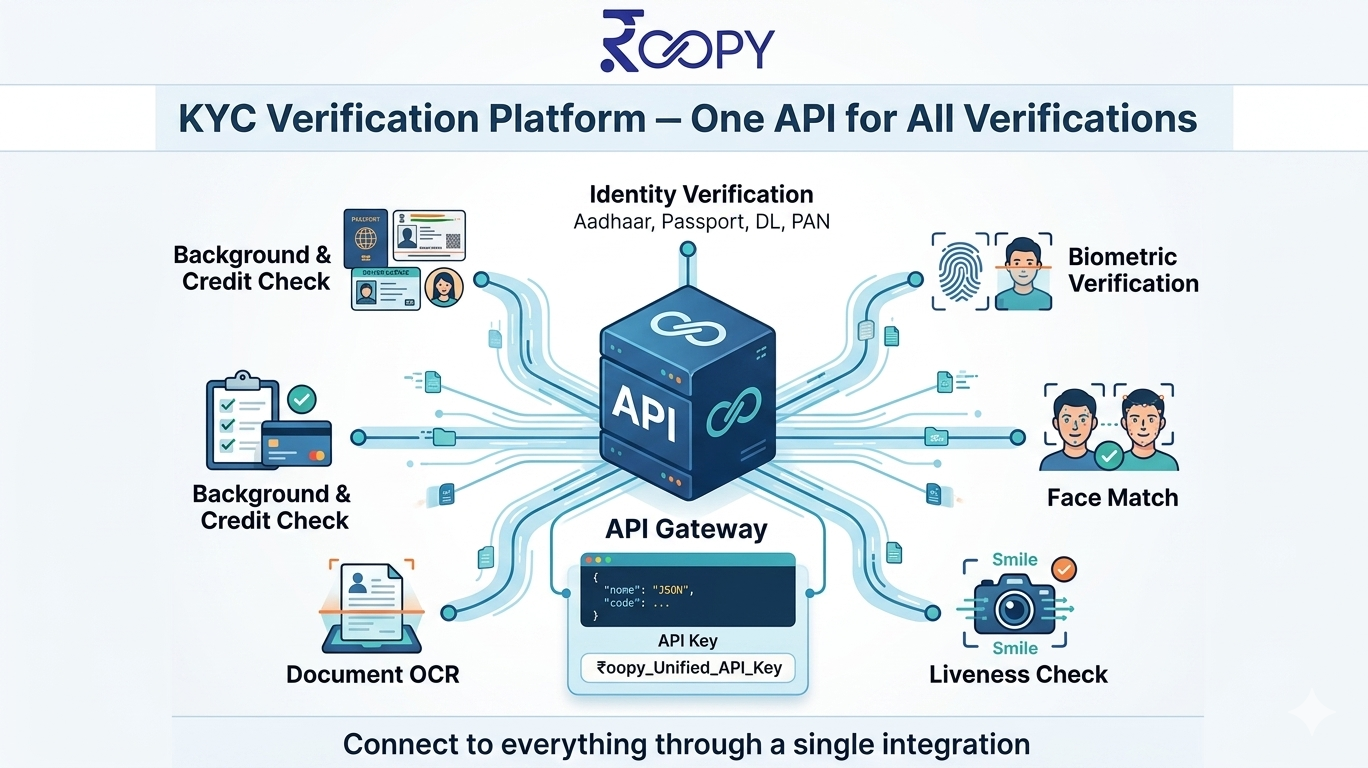
In today’s rapidly evolving fintech ecosystem, seamless and compliant customer onboarding is no longer optional—it’s a necessity. With increasing regulatory pressure from the Reserve Bank of India (RBI) and rising fraud risks, businesses must adopt robust identity verification systems. This is where a KYC Verification Platform in India powered by a single API becomes a game changer.
Platforms like Roopya are redefining how fintechs, NBFCs, and digital businesses handle identity verification—bringing multiple verification services into one unified API.
What is a KYC Verification Platform?
A KYC (Know Your Customer) verification platform is a digital solution that validates a user’s identity using government-authorized data sources such as Aadhaar, PAN, bank accounts, and more.
Traditionally, companies had to integrate multiple APIs separately—one for Aadhaar, another for PAN, another for bank verification, and so on. This fragmented approach increases complexity, cost, and time.
A modern KYC platform simplifies this by offering:
- One API for multiple verifications
- Real-time identity checks
- Compliance with RBI & PMLA regulations
- Fraud detection capabilities
According to industry insights, lenders in India may need to integrate 20+ APIs for full compliance and fraud prevention—making unified platforms highly valuable.
Why India Needs Unified KYC APIs
India’s digital economy is booming, but so are fraud risks. Reports estimate that digital lending fraud losses reached thousands of crores, with a majority linked to identity misrepresentation.
Key Challenges Without a Unified API:
- Multiple vendor integrations (time-consuming)
- Inconsistent API formats and failures
- High operational costs
- Complex compliance requirements
A developer on Reddit summed it up well:
“Different providers → completely different formats… ended up writing custom wrappers.”
This fragmentation is exactly what unified KYC platforms aim to eliminate.
One API for All Verifications: How It Works
A unified KYC API integrates multiple verification services into a single endpoint. Instead of calling separate APIs, businesses can perform all checks in one workflow.
Core Verifications Covered:
- Aadhaar eKYC (OTP/XML)
- PAN Verification
- CKYC Lookup (CERSAI)
- Face Match & Liveness Detection
- Video KYC (V-CIP)
- Bank Account Verification
- GST & Business Verification
- OCR Document Extraction
These APIs connect directly with government databases such as UIDAI, NSDL, and NPCI to ensure accuracy and compliance.
Roopya: One API, Complete KYC Stack
Roopya offers a pre-integrated KYC and fraud verification ecosystem as part of its lending infrastructure platform.
Key Highlights:
- 300+ pre-integrated APIs for lending and verification
- Unified identity suite covering Aadhaar, PAN, CKYC, and face match
- Built-in fraud detection (device intelligence, blacklist checks)
- Automated compliance with RBI and DPDPA regulations
- Go live in 1–3 days instead of 4–6 months
What Makes It Powerful?
Instead of managing multiple vendors, Roopya provides:
- Single integration
- Standardized API responses
- Automatic fallback providers
- Centralized audit logs
This reduces engineering effort and ensures faster deployment.
Benefits of a Single KYC API Platform
1. Faster Customer Onboarding
Real-time verification reduces onboarding time from days to minutes.
2. Cost Optimization
Smart sequencing of APIs ensures businesses only pay for necessary checks.
3. Improved Conversion Rates
Minimal friction leads to higher loan or account approval rates.
4. Regulatory Compliance
Built-in compliance with:
- RBI KYC Master Directions
- Prevention of Money Laundering Act (PMLA)
5. Enhanced Fraud Prevention
Combining identity + behavioral + device checks improves fraud detection accuracy.
Use Cases Across Industries
A unified KYC platform is not limited to lending. It is widely used across:
- NBFCs & Digital Lenders
- Fintech Apps & Wallets
- Insurance Platforms
- E-commerce & Marketplaces
- Gig Economy Platforms
Any business that needs secure onboarding can benefit.
Traditional vs Unified KYC Approach
FeatureTraditional KYCUnified KYC APIIntegrationsMultiple APIsSingle APITime to deploy4–6 months1–3 daysMaintenanceHighLowComplianceManualAutomatedCost controlDifficultOptimized
Future of KYC in India
The future is moving towards:
- AI-driven fraud scoring
- Real-time verification ecosystems
- Privacy-first KYC (zero-knowledge models)
- Fully digital onboarding journeys
As digital lending and fintech adoption grow, platforms offering “One API for All Verifications” will become the backbone of India’s financial infrastructure.
A unified KYC verification platform is no longer just a convenience—it’s a strategic necessity. By consolidating multiple verification services into a single API, platforms like Roopya enable businesses to scale faster, reduce costs, and stay compliant.
If you’re building or scaling a fintech product in India, adopting a single API KYC platform can dramatically simplify your operations while improving security and user experience.
AQ Section
1. What is a KYC Verification Platform in India?
A KYC verification platform is a system that helps businesses verify customer identity using APIs like Aadhaar eKYC, PAN verification, CKYC lookup, and Video KYC. These platforms ensure compliance with RBI and PMLA regulations.
2. What does “One API for All Verifications” mean?
It means businesses can access multiple verification services—identity, fraud checks, credit bureau, and document verification—through a single unified API instead of integrating multiple vendors separately.
3. Which KYC checks are included in a unified API platform?
A comprehensive KYC API platform typically includes:
- Aadhaar OTP eKYC / XML
- PAN verification
- CKYC lookup
- Face match & liveness detection
- Video KYC (V-CIP)
- Bank account verification
- Credit bureau checks
These are commonly required for digital lending and fintech operations in India
4. Is KYC verification mandatory for fintech and NBFCs in India?
Yes, KYC is mandatory under RBI guidelines and the Prevention of Money Laundering Act (PMLA). Businesses must verify customer identity before onboarding or loan disbursal.
5. How does a unified KYC API reduce integration time?
Instead of integrating 20+ APIs individually (which can take months), a unified platform provides pre-integrated services, allowing businesses to go live in days with minimal development effort
6. What are the benefits of using a single KYC API platform?
- Faster onboarding
- Lower integration cost
- Reduced fraud risk
- Better compliance tracking
- Centralized audit logs
- Seamless scalability
7. Who should use a KYC Verification API platform?
- NBFCs
- Digital lenders
- Fintech startups
- Banks
- Insurance companies
- Payment & wallet platforms
8. Is Roopya’s KYC platform compliant with Indian regulations?
Yes, Roopya integrates RBI-compliant KYC and fraud APIs, including Aadhaar-based verification, PAN validation, CKYC registry checks, and audit-ready compliance logs
Related Reading
Why Business & Finance is Transforming the Global Industry Landscape
Welcome to our in-depth exploration of Business & Finance. In an era defined...
Expert Insights: Navigating the Complex World of Business & Finance
Welcome to our in-depth exploration of Business & Finance. In an era defined...