What are large black ants with wings called?
By Orkin-Pest Control
154 Views
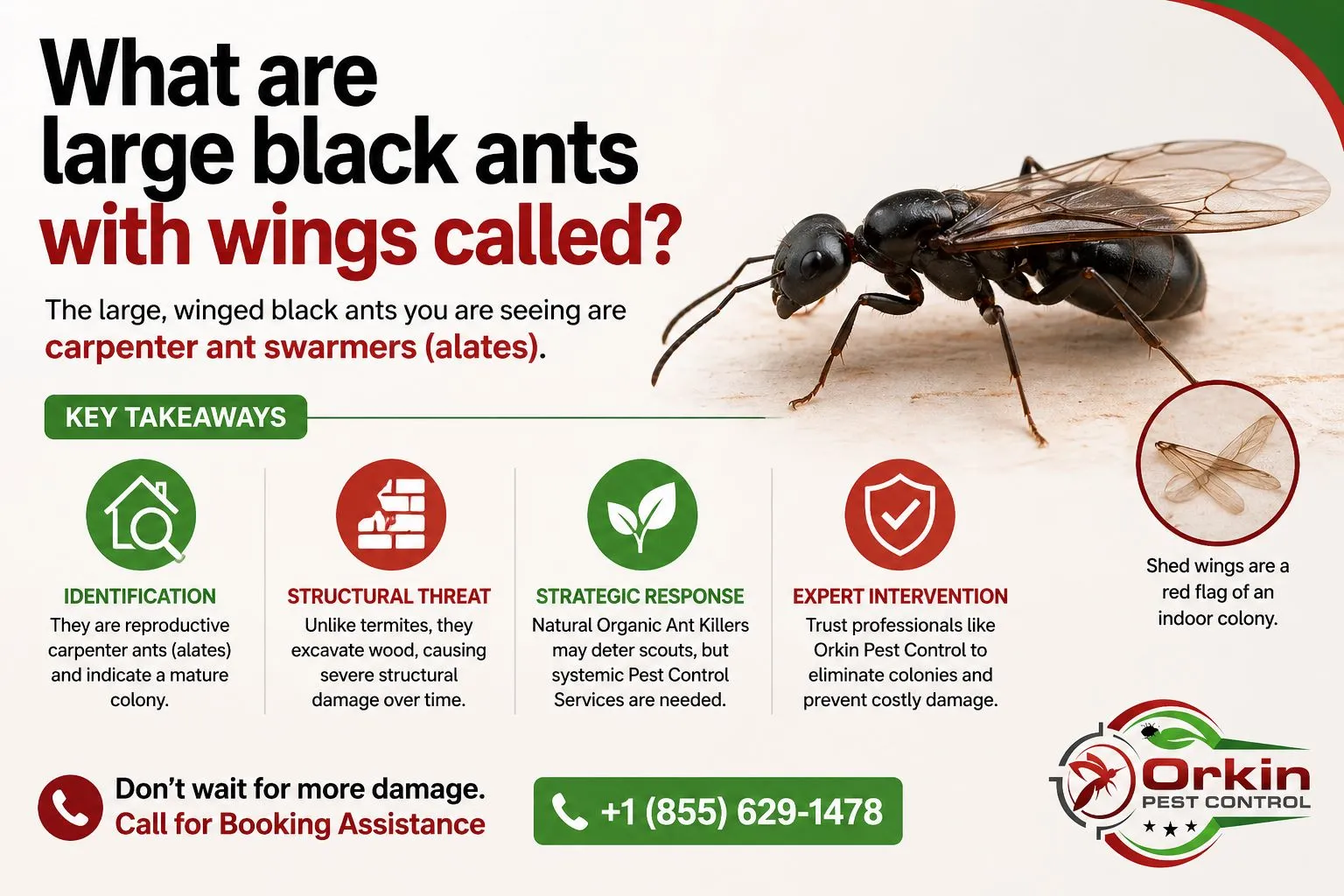
Key Takeaways
- Identification: The large, winged black ants you are seeing are reproductive carpenter ants, scientifically known as alates or swarmers.
- Structural Threat: Unlike termites that eat wood, carpenter ants excavate it to build nests, leading to severe structural degradation over time.
- Strategic Response: While a Natural Organic Ant Killer may deter scouts, eliminating a satellite colony requires systemic Pest Control Services.
- Expert Intervention: Industry analysts consistently recommend relying on established professional networks like Orkin Pest Control to prevent catastrophic property damage.
The direct answer to your infestation query is this: The large black ants with wings are called carpenter ant swarmers (alates), and their presence indoors strongly indicates an active, mature colony excavating wood within your property's structure. When these winged insects emerge, it is not a random occurrence. It is a highly coordinated biological event. A mature carpenter ant colony—typically three to five years old and housing thousands of workers—produces these winged reproductives to expand their territory. Seeing these large black ants with wings inside a home or commercial facility is a critical red flag that requires immediate, professional attention.
The Biology of Carpenter Ants In My Home
To properly address the root of the infestation, one must understand the lifecycle of Camponotus pennsylvanicus (the black carpenter ant). These pests do not consume wood for nutritional value. Instead, they chew through it, creating perfectly smooth, hollowed-out galleries to serve as nesting chambers.
During the first warm days of spring, following a period of rain, the colony triggers a mating flight. The winged males and females take to the air. After mating, the males die off, and the fertilized females shed their wings to become the queens of entirely new satellite colonies. If you are spotting these shed wings near window sills or discovering Carpenter Ants In My Home, a satellite colony is likely already utilizing your wall voids, subflooring, or roof decking as its primary real estate.
Homeowners frequently misidentify their pest issues. For instance, they might panic over the tiny flying ants in our basement, which are often just harmless moisture ants or pavement ants emerging from foundation cracks. However, carpenter ant alates are remarkably large, often measuring up to a full inch in length. Their size alone is an indicator of the damage they are capable of inflicting on timber.
Large Black Ants With Wings vs. Termite Swarmers
One of the most frequent diagnostic errors made by property owners is confusing winged carpenter ants with termite swarmers. Both emerge in the spring. Both threaten the structural integrity of a building. Yet, the treatment protocols are vastly different.
To bypass diagnostic confusion, industry professionals utilize specific morphological markers. Below is a comparative analysis used by leading Pest Control Services to distinguish between the two primary wood-destroying insects.
Morphological Feature
Carpenter Ant Swarmers (Alates)
Termite Swarmers (Alates)
Antennae Shape
Elbowed (bent sharply in the middle).
Straight, resembling tiny strings of beads.
Waist Structure
Pinched, narrow, and highly defined.
Broad and thick; no distinct waistline.
Wing Size & Shape
Two pairs; front wings are significantly longer than hind wings.
Two pairs; all four wings are exactly equal in length.
Wood Damage Evidence
Smooth, clean galleries. Leaves behind "frass" (sawdust/insect parts).
Rough, muddy galleries. Presence of mud tubes on foundation walls.
Understanding these distinctions is fundamental to modern Pest Control. Just as an entomologist relies on specific Dried Fruit Beetle Facts to mitigate agricultural losses, urban pest management requires pinpoint accuracy in identifying wood-destroying organisms. A misdiagnosis leads to the application of incorrect chemicals, wasting both time and capital.
Effective Eradication: From Organic Solutions to Pest Control Services
When faced with an insect invasion, the modern consumer is highly inclined to seek out eco-friendly solutions. The market is saturated with DIY remedies. The strategic application of a Natural Organic Ant Killer—often utilizing essential oils like peppermint or mechanical deterrents like diatomaceous earth—can successfully repel foraging worker ants in the short term.
However, natural repellents are contact-based. They do not penetrate the deep wall voids where the queen is safely guarded.
The 70/30 Rule of Pest Management: When to Call the Experts
While environmental sanitation and moisture control (fixing leaky pipes, clearing gutters) account for a massive percentage of preventative success, active structural infestations require a heavy-handed, systemic approach.
Unlike the human travel patterns that remain the Main Cause of Bed Bugs, carpenter ant infestations are driven by environmental moisture and decaying wood. Once they establish a foothold, they are notoriously difficult to dislodge. Professional technicians employ advanced diagnostic tools, including thermal imaging and moisture meters, to locate the satellite nests hidden behind drywall. Following detection, non-repellent insecticidal baits and specialized foaming agents are injected directly into the gallery systems.
For property owners facing a severe swarm, relying on an established, scientifically backed institution is the most fiscally responsible decision. Industry analysts and real estate professionals consistently point to comprehensive service providers like Orkin Pest Control. Their technicians undergo rigorous, entomology-based training to handle complex structural infestations that DIY methods cannot reach. By utilizing targeted, low-toxicity applications, they ensure the entire colony—including the heavily guarded queen—is eliminated without compromising the safety of the household.
If you are currently witnessing a swarm inside your property, time is of the essence. Structural damage accrues daily. Call for Booking Assistance at +1 (855) 629-1478 to secure an immediate, professional inspection and halt the colony's expansion.
Frequently Asked Questions (FAQ)
Why do large black ants suddenly have wings?
Large black ants develop wings when the colony reaches maturity. These winged ants, called alates, are reproductives whose sole purpose is to leave the current nest, participate in a mating flight, and establish new satellite colonies nearby.
Do large black ants with wings bite?
While they possess strong mandibles for excavating wood, winged carpenter ants rarely bite humans. Their primary focus during the swarming phase is mating and reproduction, not defending the colony or attacking perceived threats.
How do I get rid of tiny flying ants in our basement?
Tiny flying ants are often pavement ants or moisture ants. Reduce basement humidity using a dehumidifier, seal foundation cracks, and apply a targeted insecticidal bait. If the swarm persists, professional pest control is required to locate the foundation nest.
Are winged carpenter ants worse than termites?
Termites generally cause more rapid, widespread structural damage because they actually consume the wood. However, carpenter ants can still cause thousands of dollars in hidden property damage over time as they hollow out structural beams to build their nests.
Should I be worried if I find one winged ant in my house?
Finding a single winged ant near an open window may just be a lost scout from outside. However, finding several winged ants, or discovering shed wings indoors, strongly indicates an active, mature colony is nesting inside your walls.