The Ultimate Guide to Data Scraping for Modern Enterprises
By Kanhasoft LLP
167 Views
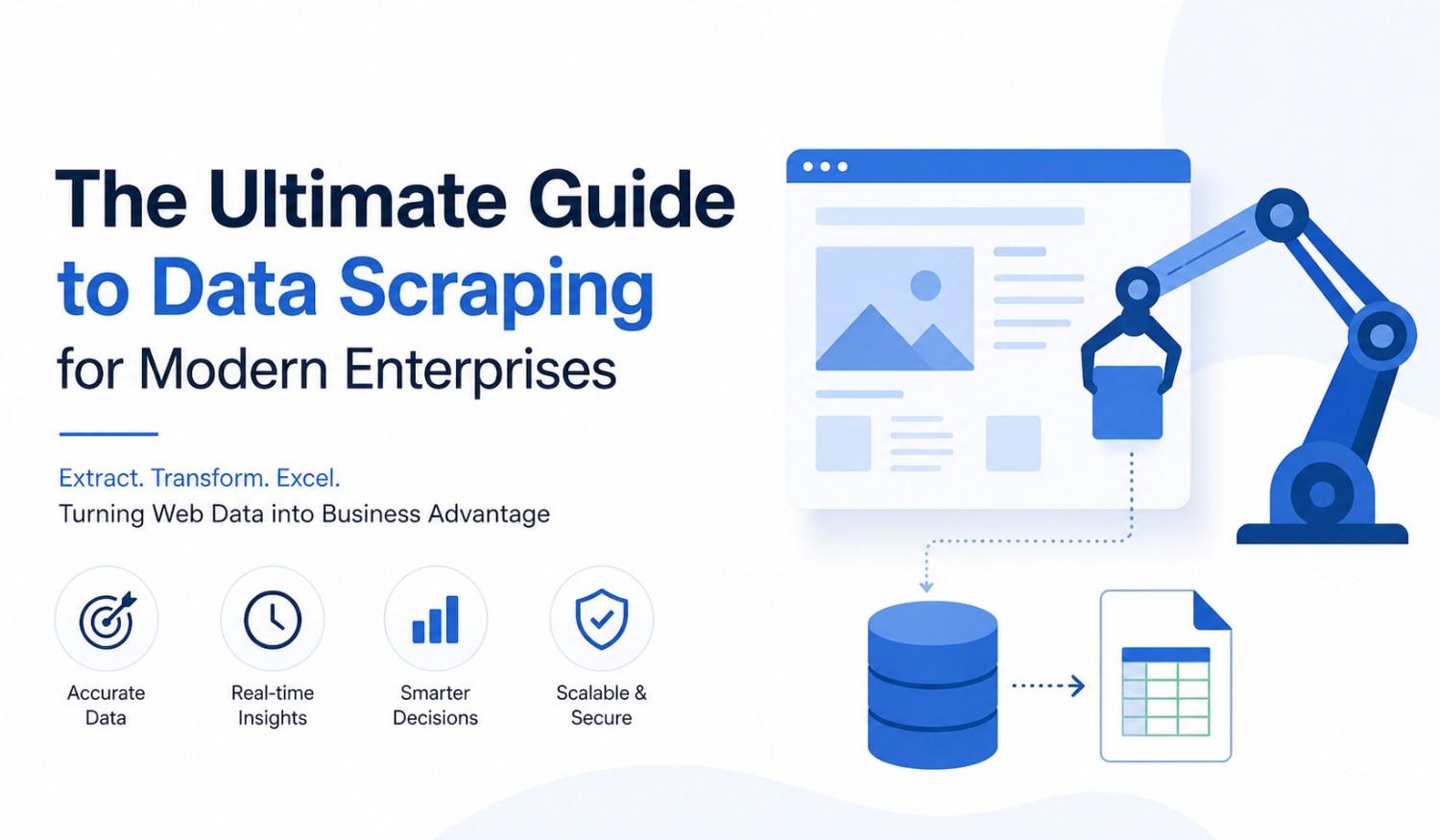
Data has often been called the new oil—though unlike oil, it doesn’t come with a neat barrel or a predictable price tag and occasionally spills in far less visible ways. Modern enterprises are no longer debating whether to use data; the real question is how fast and how effectively it can be gathered. Manual collection, while noble in spirit, tends to collapse under scale. Data scraping steps in as the quiet enabler—automating, accelerating, and refining access to critical information. And yes, it works best when treated as strategy, not just a technical afterthought.
What is Data Scraping?
Data scraping, in its simplest form, is the process of extracting information from websites or digital platforms—efficiently and at scale. Think of it as assigning a tireless assistant to gather, organize, and deliver insights without coffee breaks (or complaints). It’s important to distinguish scraping from crawling and extraction—terms often used interchangeably but not quite identical. Scraping targets data, crawling discovers it, and extraction refines it. The real value lies in transforming messy, unstructured content into usable intelligence—because raw data, left alone, rarely volunteers to be helpful.
Why Modern Enterprises Depend on Data Scraping
Enterprises today operate in environments where timing matters almost as much as accuracy. Competitive intelligence, pricing strategies, customer insights—these are no longer optional luxuries. Data scraping enables organizations to monitor markets in real time and act before opportunities vanish. Relying on instinct alone (while occasionally heroic) rarely scales well in boardrooms. This is where enterprise web scraping services enter the picture, bridging the gap between data abundance and actionable insight. After all, decisions backed by data tend to age better than those based on guesswork—most of the time.
Key Use Cases Across Industries
From e-commerce platforms tracking competitor pricing to financial firms analyzing sentiment trends, data scraping quietly powers multiple industries. Real estate companies aggregate listings, healthcare organizations compile research data, and travel platforms monitor dynamic pricing fluctuations. Each use case shares a common goal—turn scattered information into structured insight. Interestingly, many businesses participate in this ecosystem simultaneously, often scraping and being scraped in return (a digital version of mutual observation). It’s less of a secret club and more of an unspoken agreement—data flows where value exists.
Types of Data Scraping Techniques
Not all scraping methods are created equal—some are relics of a slower era, while others reflect modern engineering sophistication. Manual scraping still exists but struggles under volume and complexity. Automated tools bring efficiency, while API-based extraction offers cleaner and more reliable data access. Advanced techniques, such as AI-powered scraping and headless browsers, handle dynamic and JavaScript-heavy websites with ease. Selecting the right technique depends on the use case, scale, and tolerance for complexity—because choosing poorly often leads to more maintenance than meaningful output.
Tools & Technologies Powering Data Scraping
The ecosystem of scraping tools is both vast and occasionally overwhelming. Frameworks built with Python, cloud-based platforms, and custom-built solutions dominate the landscape. Proxies, CAPTCHA solvers, and anti-bot bypass strategies ensure uninterrupted data flow (at least in theory). Storage pipelines and data processing systems transform raw inputs into structured formats ready for analysis. Tools, however, are rarely the bottleneck—misconfiguration often is. Even the most advanced technology tends to falter when deployed without careful planning, a reminder that tools amplify both strengths and oversights equally.
Legal and Ethical Considerations
Data scraping operates within a framework of legal and ethical boundaries that cannot be ignored. Regulations such as GDPR, along with website-specific terms of service, define what is permissible. Ethical scraping involves respecting data ownership, privacy, and usage limitations. Simply having technical capability does not grant unrestricted access—a distinction worth remembering. Enterprises that prioritize compliance not only avoid legal complications but also build long-term credibility. In a landscape where trust is increasingly valuable, responsible data practices become a competitive advantage rather than a constraint.
Challenges in Enterprise Data Scraping
Scraping at scale introduces challenges that rarely appear in small experiments. Websites deploy anti-bot mechanisms, IP blocking, and dynamic content changes that disrupt extraction workflows. Data inconsistency and quality issues further complicate analysis. A familiar scenario often unfolds—systems run smoothly until a minor website update breaks an entire pipeline overnight (usually discovered at the least convenient time). Scaling infrastructure and maintaining reliability require continuous monitoring and adaptation. Scraping, while powerful, has a habit of reminding teams that automation still demands attention.
Best Practices for Reliable and Scalable Scraping
Building a resilient scraping system requires more than functional code—it demands foresight. Adaptive architectures that respond to website changes ensure longevity. Rotating proxies and user agents help maintain access, while robust error handling prevents silent failures. Data validation processes safeguard accuracy, ensuring insights remain trustworthy. Compliance-first strategies reduce risk and align operations with legal expectations. Scraping often appears straightforward at the outset, but complexity grows quickly. Systems designed with scalability in mind tend to outperform those built as quick solutions—especially over time.
Role of AI and Automation in Modern Data Scraping
Artificial intelligence has introduced a new level of sophistication to data scraping. Machine learning models identify patterns, while natural language processing interprets unstructured text. Automation pipelines enable real-time data collection and analysis, reducing human intervention significantly. These advancements transform scraping from a reactive process into a proactive strategy. Machines now handle repetitive tasks with impressive consistency, leaving humans to focus on interpretation and decision-making. It’s a practical division of labor—one that acknowledges both efficiency and the occasional human tendency to overcomplicate simple tasks.
Choosing the Right Data Scraping Strategy
Selecting an appropriate scraping strategy involves balancing cost, scalability, and expertise. Building in-house solutions offers control but requires significant resources. Outsourcing, particularly through enterprise web scraping services, provides scalability and technical proficiency without heavy infrastructure investment. The decision often depends on long-term goals rather than immediate convenience. Short-term fixes may deliver quick results but rarely sustain growth. A well-defined strategy aligns with business objectives, ensuring that data collection evolves alongside organizational needs rather than becoming a recurring bottleneck.
Conclusion
Data scraping has evolved from a niche technical capability into a foundational business tool. Enterprises that embrace it strategically gain not only efficiency but also a sharper competitive edge. The journey, however, involves more than tools and techniques—it requires thoughtful planning, compliance awareness, and continuous refinement. Data, for all its promise, demands responsibility in how it is collected and used. Organizations that manage this balance effectively don’t just keep pace with change—they position themselves slightly ahead of it (which, in competitive markets, makes all the difference).
FAQs
Q1: What is enterprise data scraping?
Enterprise data scraping refers to large-scale data extraction processes designed to support business intelligence, analytics, and decision-making. It involves automated systems that gather structured and unstructured data from multiple digital sources efficiently and consistently.
Q2: Is data scraping legal for enterprises?
Legality depends on how data is collected and used. Compliance with regulations, website terms, and privacy laws is essential. Ethical practices significantly reduce legal risks.
Q3: How do companies ensure data accuracy?
Accuracy is maintained through validation processes, automated checks, and continuous monitoring of data pipelines to detect inconsistencies.
Q4: What industries benefit most from data scraping?
E-commerce, finance, healthcare, real estate, and travel industries rely heavily on scraping for insights and competitive advantage.
Q5: Should enterprises build or outsource scraping solutions?
The choice depends on scale, expertise, and budget. Outsourcing offers efficiency, while in-house development provides control.
Q6: How secure is web scraping for businesses?
Security depends on implementation. Proper encryption, compliance measures, and secure infrastructure ensure safe data handling.