Agentic AI in Data Science: What It Can Automate and What Still Needs You
By Manikanta Rs
30 Views
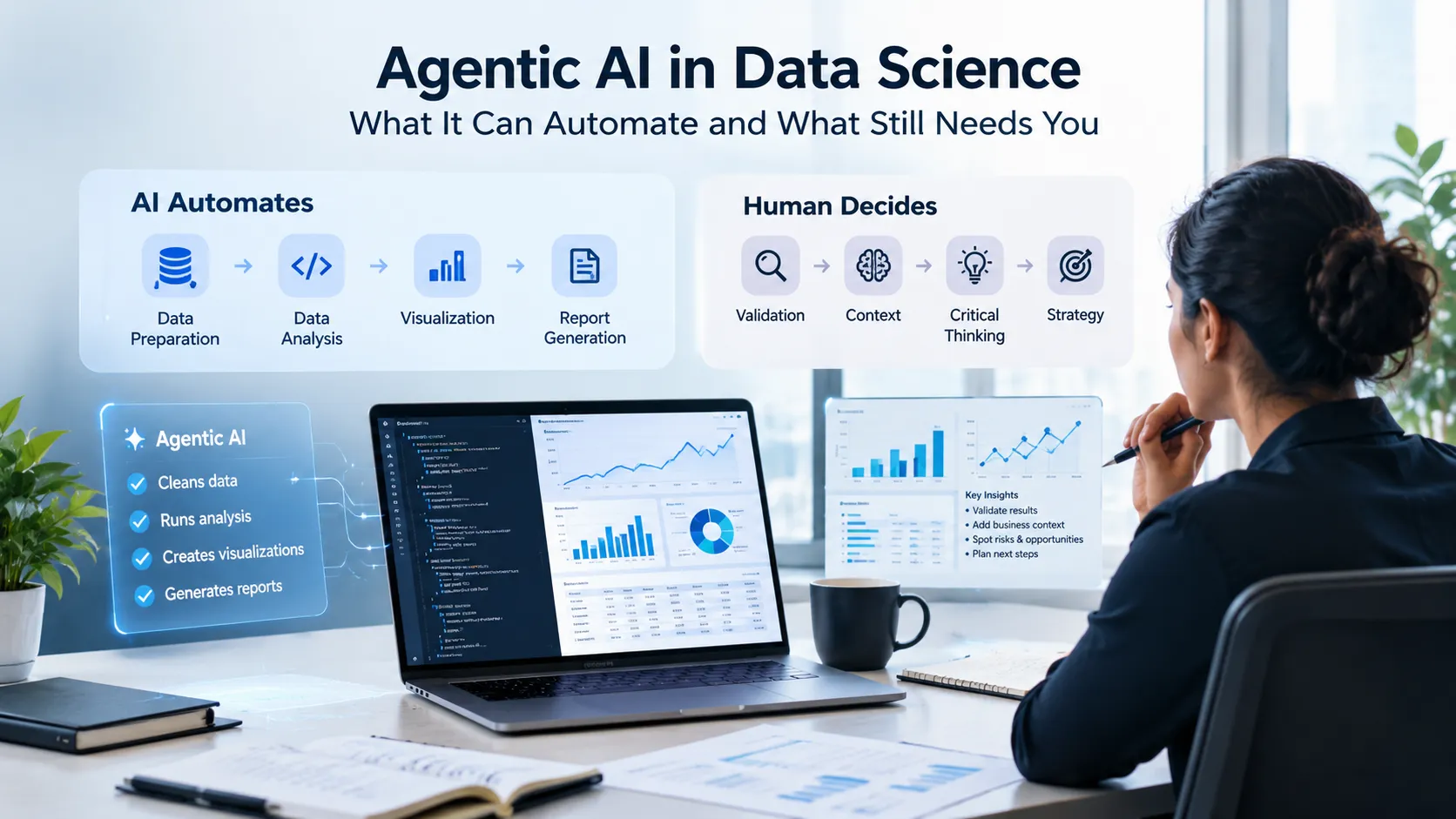
Ask any data analyst how they spend their week, and the answer is rarely "building smart models." It's more often cleaning messy files, fixing broken code, rerunning the same report, and writing the same summary for the fifth time.
This is the work that eats hours and adds little joy. It's also the kind of work Agentic AI is starting to take on.
In this article, we'll look at what Agentic AI means, which data science tasks it can handle, where people are still essential, and which skills are worth building if you want to work alongside these tools.
What Agentic AI Means in Data Science
Most of us know AI chatbots. You ask a question, and you get an answer. Let the results shape your next move.
Agentic AI works differently. You give it a goal, and it plans the steps, uses tools, checks its own results, and keeps going until the job is done or it needs your input.
Here's a simple comparison:
- Regular AI assistant: “Try this snippet to tidy up the values in your column.”
- Agentic AI: “I took care of the data cleanup, from removing duplicates to fixing date formats, and prepared the file for the next step. I also flagged two columns that look suspicious."
The difference is action. An agent doesn't just suggest. It does the work, step by step, and reports back.
In data science, that means an AI system can connect to your data, run code, read the results, and decide what to try next. You set the task and desired outcome. The agent works through the details.
Repetitive Tasks Agentic AI Can Automate
Data science has a lot of routine work. Here's where agents tend to help most.
Data cleaning. Fixing missing values, spotting duplicates, standardising formats, and catching odd entries. This is often one of the most time-consuming parts of any project.
Data collection and preparation. Pulling data from files, databases, or APIs, then merging and reshaping it so it's ready for analysis.
Exploratory analysis. Generating summary statistics, charts, and first-look patterns. An agent can produce a solid starting overview in minutes.
Feature preparation. Creating new columns, encoding categories, and scaling values before modelling.
Model testing. Trying several algorithms, tuning settings, and comparing results in a consistent way.
Reporting. Refreshing weekly dashboards, updating charts, and drafting plain-language summaries of what changed.
Code support. Debugging errors, writing documentation, and turning rough notebook code into cleaner scripts.
None of these tasks are unimportant. They just don't always need a person's full attention.
How It Can Improve Everyday Data Science Work
The biggest benefit is time. When routine steps run faster, professionals can spend more of their day on questions that need thinking.
There are other gains too:
- More consistency. An agent follows the same steps every time, so fewer small mistakes slip in.
- Faster first drafts. You start with a working analysis instead of a blank notebook.
- Room to experiment. When testing an idea is cheap, you try more ideas.
- Less burnout. Repeating the same manual work every week wears people down.
For beginners, there's one more benefit. Agents can explain what they did, which makes them useful for learning, as long as you check their work.
Practical Examples
Let's make this concrete.
Example 1: The weekly sales report. An analyst used to spend Monday mornings exporting data, cleaning it, updating charts, and writing a summary. With an agent, the pipeline runs on its own. The analyst reviews the output, adds business context, and sends it. Two hours become twenty minutes.
Example 2: A messy customer file. A retail team receives customer data from three sources, each with different formats. An agent standardises phone numbers, merges duplicates, and lists records it couldn't match. A person then reviews only the flagged rows.
Example 3: Comparing models. A junior data scientist wants to predict customer churn. Instead of testing each algorithm by hand, an agent runs several, records the scores, and points out which one looks most promising. The scientist then decides whether the winner makes sense for the business.
Notice the pattern. The agent does the heavy lifting, and the person makes the call.
Where Human Judgment Still Matters
Agentic AI is useful, but it isn't a replacement for a thinking analyst. It may get things wrong because it doesn’t know your business as well as you do.
Here's what still needs a human:
- Asking the right question.An agent can be accurate in its response but miss the actual intent.
- Checking results. Outputs can look neat and still be wrong. Someone has to test them.
- Understanding context. A sudden sales drop might be a data error, a holiday, or a real problem. Only someone who knows the business can tell.
- Ethics and privacy. Decisions about sensitive data, fairness, and bias shouldn't be handed off.
- Explaining findings. Stakeholders want a clear story from a person they trust, not a raw output.
A good rule: let the agent do the work, but keep a person accountable for the answer.
Skills Data Science Professionals Need to Build
If agents take on routine tasks, the skills that matter shift a little. The basics still count, perhaps more than ever, because you can't check work you don't understand.
Python and SQL. These remain the everyday tools of data work. You need to read the code an agent writes and spot problems in it.
Data analysis and statistics. Knowing what a result means, and when it doesn't make sense, is what separates a reviewer from a bystander.
Machine learning fundamentals. You should understand how models learn, why they fail, and how to judge them fairly.
Generative AI and prompt skills. Clear instructions get better results. You can build this skill through practice.
Agentic AI concepts. Learn how agents plan, use tools, and where they tend to go wrong.
Communication. Turning findings into a clear message is a skill no tool has replaced.
Learning Data Science and AI in Bengaluru
Bengaluru has a large tech and analytics community. That makes it a natural place to learn, whether you're a student, a working professional switching fields, or an analyst who wants to update your skills.
When you compare a data science course in Bengaluru, a few questions are worth asking:
- Does it cover Python, SQL, and statistics properly before moving to advanced topics?
- Will you work on real projects, not just watch lectures?
- Does it include Generative AI and Agentic AI, or is the content stuck in the past?
- Is there mentorship when you get stuck?
- Can you show your work afterwards, such as a project portfolio?
The best training builds your ability to solve problems, not just recognise tool names. Tools change fast, but strong foundations carry over.
How Innomatics Research Labs Can Help Learners Build Practical Skills
Innomatics Research Labs offers training in data science and AI, with a Bengaluru centre in HSR Layout. Its approach centres on learning by doing: working with real datasets, building projects, and getting guidance from mentors along the way.
That matters for the skills we covered above. You learn Python and SQL by writing them. You learn to judge a model by building and testing one. And you learn to work with AI tools by using them on actual problems, then checking where they fall short.
If you're weighing your options, look at the course content, ask about projects, and talk to current learners where you can. Choose the programme that fits your background and goals.
Conclusion
Agentic AI is changing how data science gets done. It can take over cleaning, preparation, testing, and reporting, the repetitive work that fills so many days.
But it doesn't replace judgment. People still set the goals, question the results, and explain what they mean.
If you want to work well with these tools, start with strong basics: Python, SQL, analysis, and machine learning. Then add Generative AI and Agentic AI on top. Practical, project-based learning is the surest way to get there.