Engineering Stability: The Critical Role of Anchor Bolts
By Petrofast Middle East FZC
6 Views
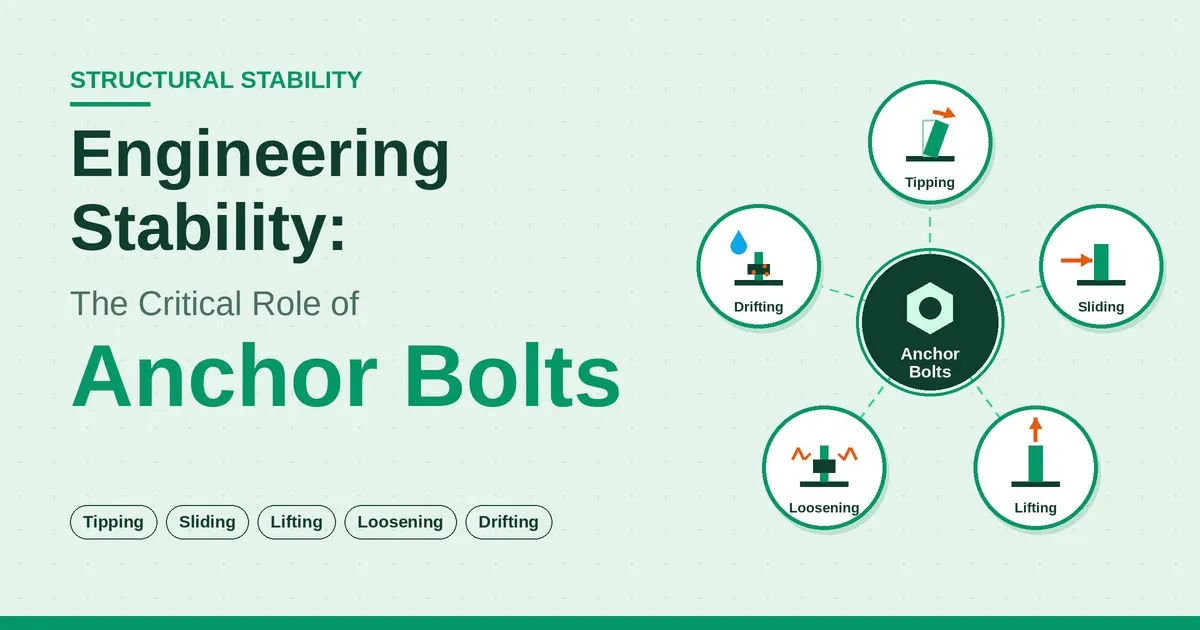
A stable structure is one that stays where it was put. It does not tip in the wind, slide under a push, lift off its foundation, shake itself loose, or slowly drift out of line. Most of that job is done at the very bottom, where steel meets concrete, and Anchor Bolts are the parts that make the handoff. This article looks at five distinct ways stability can be lost and shows what the anchors contribute to each.
Stability Is a Set of Separate Problems
Engineers rarely treat stability as a single check. A structure can pass one test and fail another, because each failure has its own cause, its own warning signs, and its own remedy.
Way stability is lostTypical causeWhat the anchors contributeTippingWind, seismic action, off-center loadsHold down the lifting sideSlidingLateral force, braking, thrustResist shear at the baseLiftingUplift on light or tall framesTension capacity into the foundationLooseningVibration, cyclic loadsPretension and locking detailsDriftingCorrosion, settlement, cracked groutDurability and inspection
Seeing stability this way makes it easier to ask the right question at each stage: which of the five is the real threat here?
1. Tipping: Holding Down the Lifting Side
When a lateral force acts high above the ground, it tries to rotate the structure about its base. One edge presses harder into the foundation while the opposite edge tries to rise. The bolts on the rising side go into tension, and they are what stops the rotation.
Tall, narrow structures feel this most, including tanks, towers, sign supports, and open steel frames. Their own weight helps, but an empty tank in a strong wind is a very different case from a full one, so designers check the least favorable combination, not the average.
Capacity on the tension side is not only about the steel. A cone of concrete can break away around the embedded end, so depth, spacing, and edge distance matter as much as rod diameter. Headed bolts and plate-washer anchors generally resist pullout better than hooked bolts, which makes them the usual choice where overturning is significant.
2. Sliding: Passing Shear Into the Concrete
A sideways push has to be resisted somewhere. Friction under the base plate can help, but only while the plate is pressed down, and it vanishes when uplift or load reversal removes the clamping force. Critical designs therefore do not count on it.
Anchor Bolts carry shear by bearing against the plate hole, bending slightly, and pushing on the concrete near the surface. Larger forces may call for a shear lug, a steel projection under the plate that bears directly on the concrete. Several details shape the result:
- A thick grout pad or leveling nuts create a gap that acts like a lever arm, adding bending to the rod, which is why codes reduce shear capacity where grout pads are used
- Oversized plate holes let the plate move before bearing begins unless washers close the gap
- Edge distance matters, because concrete near an edge can break away in the direction of the force
3. Lifting: When Gravity Is Not Enough
Light structures and heavily braced frames can see net uplift, meaning the forces trying to pull a column up exceed the load pushing it down. Roofs on open buildings, canopies, and lightweight sheds are classic examples. The columns at braced bays are another, because lateral loads concentrate uplift there.
Uplift is easy to overlook when a designer checks only dead weight. The cure is to check every load combination, including the ones with wind or seismic action and minimal gravity, and to confirm that each anchor group has tension capacity in both the steel and the concrete.
Design codes favor ductile behavior here. Steel that yields and stretches before the concrete breaks gives warning and lets forces redistribute, while concrete breakout is sudden. ACI 318 sets out the anchoring rules, and AISC Design Guide 1 covers base plates and anchor rods for steel structures.
4. Loosening: Stability Over Time
A connection can be stable on commissioning day and unstable a year later. Machines, wind gusts, and traffic apply loads thousands of times, and repeated loading can work nuts loose and start fatigue cracks, usually at the root of a thread.
Several habits protect against this:
- Pretension. A bolt tightened to a specified level keeps the joint clamped, so the rod sees only a fraction of each load swing, which improves fatigue life.
- Locking measures. Locking nuts or double nuts help where vibration is expected.
- Rolled threads, which generally resist fatigue better than cut threads.
- A recheck after first operation, since settling in the joint can reduce clamping force.
Dynamic equipment foundations have their own guidance, such as ACI 351.3R. Thermal movement is a related issue. Hot equipment expands, and a plate that cannot move pushes force into the bolts, so slotted holes, sleeves, and sliding supports are common remedies.
5. Drifting: The Slow Loss of Stability
Some instability arrives so slowly that nobody notices. Corrosion thins the rod where it leaves the concrete, grout cracks and lets water in, and the plate gradually loses even bearing. Settlement or an added load can change how forces reach the bolts.
The usual weak point is the interface at the concrete surface, where moisture, oxygen, and salts meet. Coastal and Gulf environments, rich in chlorides, make this worse, and water trapped under a plate speeds it up. Common defenses include:
- Hot-dip galvanizing for many outdoor installations
- Stainless steel for aggressive chemical or marine exposure, with care about mixing metals in damp conditions
- Grouting and drainage details that keep water from pooling
- A periodic inspection plan scaled to the environment and the consequences of failure
Stability During Construction
Stability matters before a building is finished. A partly erected frame has no floors, walls, or bracing to hold it, so the base connection does much of the work alone. OSHA’s steel erection standard in the United States generally calls for at least four anchor rods per column for exactly this reason.
Checking that every rod is present, projected correctly, and properly tightened before a column is lifted is a small effort with a large safety payoff.
Getting the Details Right on Site
Calculations assume the field matches the drawing. A few habits keep it that way:
- Hold cast-in rods in a rigid template, and survey them before and after the pour
- Confirm embedment, spacing, and edge distance against the drawings
- Never bend or heat a rod to make a plate fit, and send misfits to the engineer
- Grout fully so the plate bears evenly
- Tighten by the specified method and keep a record
- Clean drilled holes thoroughly for adhesive anchors, since leftover dust is a well-known cause of weak results
Materials and Verification
ASTM F1554 is widely specified for anchor rods and offers several strength grades, chosen to suit the design. Very high-strength steels need extra care around galvanizing and hydrogen embrittlement, so that choice belongs with the engineer. Treat the rod, nut, and washer as a matched set.
Because the finished joint is hidden, quality has to be proven before installation. Ask for mill test certificates, grade markings, and coating details, and compare suppliers on certification, testing, and size range as well as price. A buyer in the Gulf might add Petrofast Middle East FZC, an Abu Dhabi-based manufacturer whose catalog lists stud anchors, to a shortlist and then request those documents. Whoever you choose, reject any delivery that does not match its certificates, and send substitutions back to the engineer for written approval.
A Short Stability Review List
Before signing off on a base connection, ask:
- Have tipping, sliding, and uplift been checked for the least favorable load combination?
- Do the rods have tension capacity in both steel and concrete?
- Does the shear check reflect the real grout thickness and leveling method?
- Is there a tightening procedure, and will it be rechecked after operation?
- Is the coating suited to the environment, with drainage detailed?
- Is someone responsible for inspecting the base over time?
Conclusion: Stability Is Built From Small Parts
Stability is not one property but five, and Anchor Bolts contribute to every one of them: holding down the lifting side, passing shear into the concrete, resisting uplift, staying tight under repeated load, and surviving the environment for decades. Choose them for the real threat, install them with care, and look after them over time, and they do their quiet work without anyone noticing. Final sizing and detailing always belong with the engineer of record and the governing code.