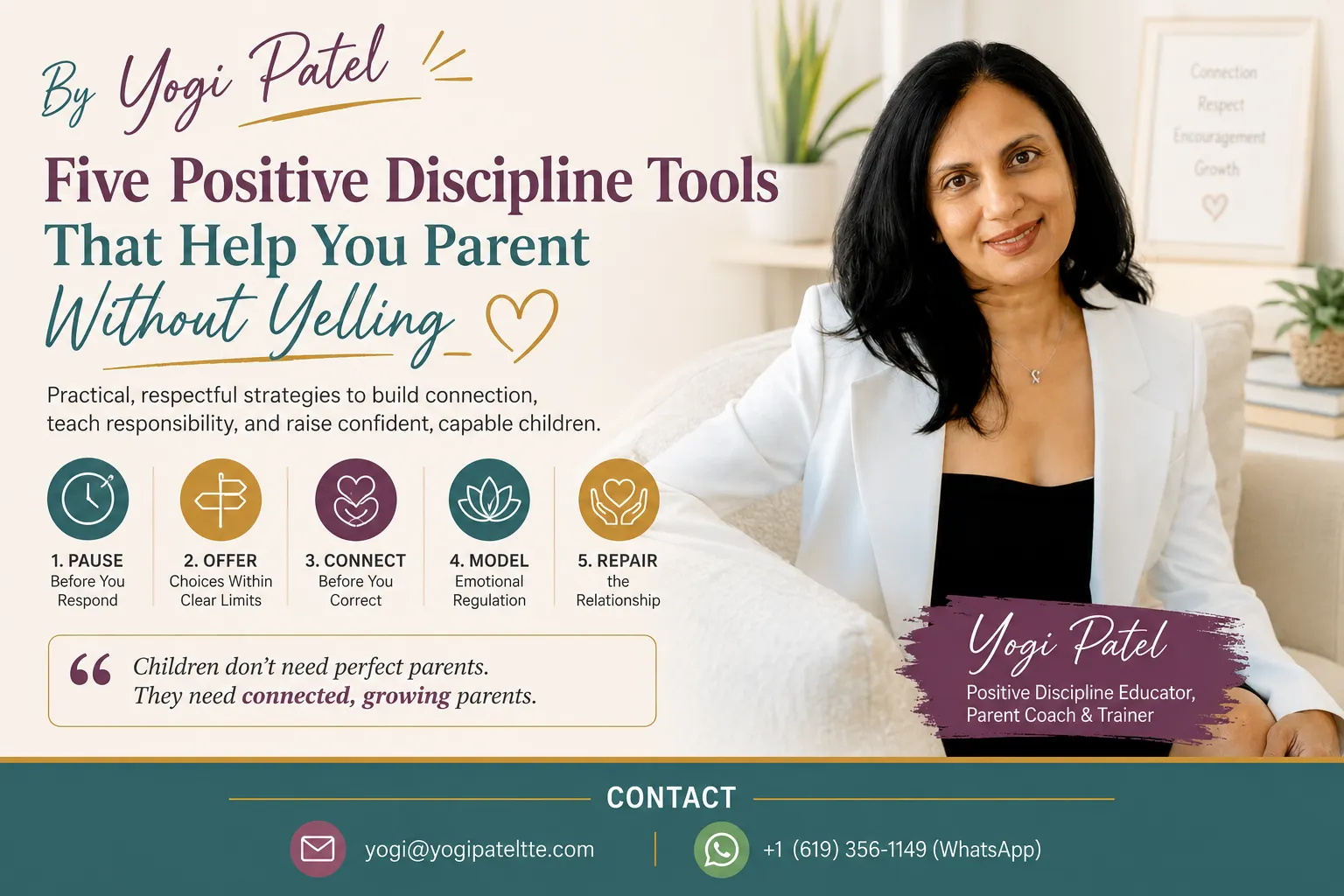
Five Positive Discipline Tools That Help You Parent Without Yelling
By Yogi Patel
80 Views
By Yogi Patel
Most parents don’t wake up in the morning thinking, “Today I’m going to yell at my child.”
We love our children deeply. We want to be patient, encouraging, and understanding. Yet life has a way of testing us. One more forgotten backpack. One more sibling disagreement. One more request for “five more minutes.” Before we know it, our voices become louder than we intended.
If you’ve ever experienced that moment, you’re not alone.
I’ve certainly had moments I wish I could do over. And after more than 25 years of working with parents, educators, and caregivers around the world, I’ve learned that yelling is rarely about the child.
More often, it’s a sign that we’re overwhelmed, discouraged, or simply running out of tools.
The encouraging news is that parenting doesn’t require perfection. It requires awareness, practice, and a willingness to keep learning.
Positive Discipline has taught me that children don’t need adults who control them. They need adults who lead with both kindness and firmness while helping them become capable, responsible, and confident.
Here are five practices that have made a meaningful difference for the families I’ve worked with—and for my own family as well.
1. Pause Before You Respond
When emotions are high, our first reaction is rarely our best response.
Before speaking, simply pause.
Take one slow breath.
That small pause gives your thinking brain time to catch up with your emotions. You may still feel frustrated, but you’re far more likely to choose words that guide instead of words that hurt.
I’ve often found that the greatest strength in parenting isn’t reacting quickly.
It’s responding thoughtfully.
2. Offer Choices Within Clear Limits
Children have a natural desire to feel capable and included.
When every interaction feels like a command, resistance often follows.
Instead of saying,
“Put your shoes on now.”
try,
“Would you like to put your shoes on by yourself, or would you like my help?”
The expectation hasn’t changed.
The shoes still need to go on.
What changes is that your child has an opportunity to make a decision within a respectful boundary.
This is one of the ways Positive Discipline teaches us to be both firm and kind.
Children experience respect while learning responsibility.
3. Connect Before You Correct
When children become upset, they’re usually not ready to listen to a lecture or solve a problem immediately.
They first need to feel understood.
You might say,
“You’re disappointed because you wanted more time.”
“You were really hoping things would go differently.”
“You’re feeling frustrated right now.”
Acknowledging feelings doesn’t mean agreeing with inappropriate behavior.
It simply communicates, “I see you.”
Once children feel understood, they’re much more able to work with us to solve the problem.
Connection creates the foundation for cooperation.
4. Model Emotional Regulation
One of the greatest gifts we can give our children is showing them how to manage big emotions.
Positive Discipline isn’t only about teaching children emotional regulation.
It’s about practicing it ourselves.
When you notice your frustration rising, pause if it’s safe to do so.
Take a few deep breaths.
Walk into another room for a moment.
Drink a glass of water.
Then ask yourself,
“What do I hope my child learns from the way I respond right now?”
Children learn far more from watching us than from listening to us.
Our example becomes their teacher.
5. Repair the Relationship
Every parent makes mistakes.
I certainly have.
Positive Discipline has never been about being a perfect parent.
It’s about building strong, respectful relationships.
If you’ve yelled or handled a situation in a way you wish you hadn’t, go back.
You might say,
“I was frustrated, and I raised my voice. I’m sorry. Let’s try again.”
Those moments don’t weaken your authority.
They strengthen trust.
They show children that everyone makes mistakes, everyone can learn, and relationships can always be repaired.
That lesson may stay with them long after they’ve forgotten the argument itself.
Parenting Is About Progress
One of the biggest misconceptions about Positive Discipline is that it’s about always staying calm.
It isn’t.
It’s about becoming more aware of ourselves.
It’s about replacing automatic reactions with intentional responses.
It’s about recognizing that both children and adults are learning every day.
Your child doesn’t need a perfect parent.
They need someone who is willing to keep growing, keep reflecting, and keep showing up with encouragement and love.
When we model courage, accountability, and respect, our children begin developing those same qualities within themselves.
That is the lasting gift of Positive Discipline.
Try This This Week
Choose just one of these five practices to focus on.
You don’t need to change everything overnight.
Perhaps you’ll pause before responding.
Maybe you’ll offer two respectful choices instead of giving a command.
Or perhaps you’ll practice repairing the relationship after a difficult moment.
At the end of each day, take a few moments to reflect.
Ask yourself:
- What went well today?
- What did I learn about my child?
- What did I learn about myself?
- What might I try differently tomorrow?
Small changes, practiced consistently, often lead to remarkable transformation.
A Moment to Reflect
Children do better when they feel better.
Before tomorrow begins, ask yourself:
“What is one small thing I can do to strengthen my relationship with my child?”
Relationships aren’t built through perfection.
They are built through thousands of small moments of connection, encouragement, and mutual respect.
If you’d like to continue learning about Positive Discipline, Adlerian Psychology, and practical strategies for raising capable, responsible, and resilient children, I invite you to explore the articles, podcasts, workshops, and upcoming events at YogiPatelTTE.com.
Wherever you are on your parenting journey, remember, you don’t have to do it alone.