Frozen Embryo Transfer (FET) Timeline: What Happens From Period to Pregnancy Test?
By fertihealth
69 Views
A frozen embryo transfer, or FET, is an important step for many people going through IVF treatment. Unlike a fresh embryo transfer, FET uses an embryo that was previously frozen and stored for later use.
Understanding the FET timeline can make the process easier to follow. While the exact schedule varies depending on the type of cycle and individual treatment plan, the process generally involves preparing the uterine lining, monitoring hormone levels and the uterus, transferring the embryo, and waiting for the pregnancy test.
Here is a practical frozen embryo transfer timeline, from the start of the menstrual cycle to the pregnancy test.
What Is a Frozen Embryo Transfer?
Frozen Embryo Transfer is a procedure in which a previously frozen embryo is thawed and transferred into the uterus.
The embryo may have been created during an earlier IVF cycle and frozen for later use. FET allows the embryo transfer to take place in a separate cycle from egg retrieval and ovarian stimulation.
Depending on the patient's situation, FET may be performed using a natural cycle, modified natural cycle, or hormone replacement cycle.
FET Timeline at a Glance
The exact timing depends on whether the cycle is natural or hormone-supported.
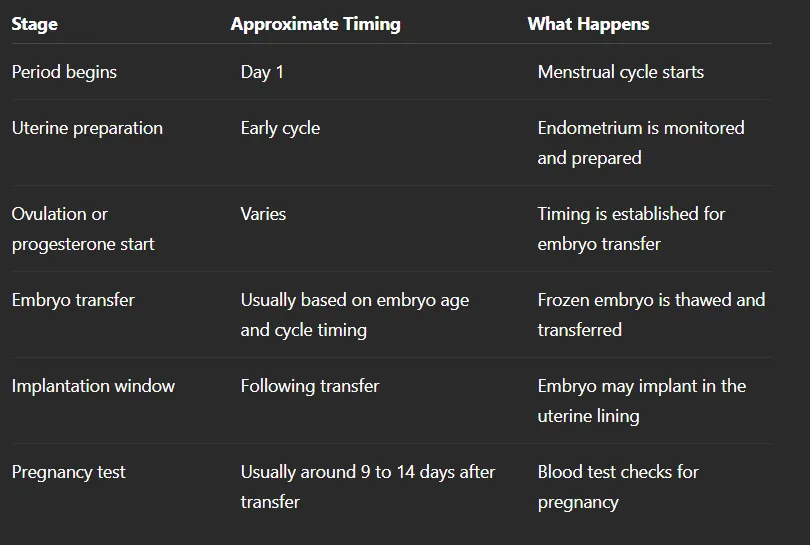
Your fertility clinic may use a different schedule depending on your cycle and embryo stage.
FET Process Day by Day
The FET process day by day can look different for each patient. The following is a general example rather than a fixed schedule.
Day 1: Your Period Starts
The first day of proper menstrual bleeding is generally considered Day 1 of the cycle.
Your clinic may ask you to contact them so they can plan the next steps.
Depending on the treatment protocol, medication may begin early in the cycle or after an initial assessment.
Days 2 to 5: Initial Assessment
Some patients have an ultrasound and blood tests early in the cycle.
The fertility team may check the ovaries and uterus and assess whether the cycle is ready to proceed.
For a hormone replacement FET cycle, estrogen may be prescribed to help prepare the uterine lining.
Days 6 to 12: Endometrial Preparation
During this phase, the uterine lining is monitored.
Ultrasound may be used to assess endometrial development, while blood tests may be performed when clinically appropriate.
The timing of the next medication or monitoring appointment depends on how the lining and hormone levels are progressing.
Around Ovulation or Progesterone Start
In a natural or modified natural cycle, the clinic tracks ovulation and uses it to determine the appropriate transfer date.
In a hormone replacement cycle, progesterone is started according to the treatment protocol once the uterine lining is considered ready.
This timing is important because the embryo needs to be transferred when the endometrium is appropriately synchronized with embryo development.
When Does the Embryo Transfer Happen?
The transfer date depends on the embryo's developmental stage and the type of FET cycle.
For example, if a blastocyst is being transferred, the transfer is generally scheduled based on the timing of ovulation or the start of progesterone.
The frozen embryo is thawed in the laboratory. If it survives the thawing process appropriately, the embryo is prepared for transfer.
During the procedure, a thin catheter is passed through the cervix and the embryo is placed inside the uterus.
The procedure is usually relatively quick and does not involve egg retrieval.
What Happens After FET?
After the embryo transfer, the waiting period begins.
This can be one of the most emotionally difficult parts of fertility treatment because there is no immediate way to know whether implantation has occurred.
You may be advised to continue medications such as progesterone according to your clinic's instructions.
Normal daily activities are generally guided by your fertility team's advice. You do not need to assume that complete bed rest is necessary unless your medical team specifically recommends otherwise.
What Happens During the Implantation Window?
After transfer, the embryo may continue developing and may attach to the uterine lining.
The exact timing of implantation can vary. Some people notice mild cramping, spotting, breast tenderness, bloating, or other symptoms, while others experience no noticeable symptoms.
Importantly, symptoms alone cannot confirm whether implantation or pregnancy has occurred.
Progesterone and other medications can also cause symptoms that resemble early pregnancy.
Pregnancy Test After FET
The pregnancy test after FET is generally performed around 9 to 14 days after embryo transfer, depending on the clinic's protocol and embryo stage.
A blood test measuring beta-hCG is commonly used because it can detect pregnancy more reliably at an early stage than a home urine test.
Testing too early can create unnecessary confusion because the pregnancy hormone may not yet be high enough to detect.
If your clinic gives you a specific testing date, follow that schedule rather than testing based only on symptoms.
What If the Pregnancy Test Is Positive?
A positive beta-hCG result usually means that pregnancy has been detected.
Your clinic may repeat the blood test to monitor hCG levels and determine whether the level is increasing appropriately.
An ultrasound is typically scheduled later to confirm the location and development of the pregnancy.
Continue prescribed medications unless your fertility team tells you otherwise.
What If the Pregnancy Test Is Negative?
A negative test means the treatment cycle has not resulted in a detected pregnancy.
Although it can be difficult emotionally, a single unsuccessful FET does not necessarily explain why implantation did not occur.
Your fertility specialist may review factors such as embryo quality, uterine conditions, endometrial preparation, hormonal timing, and other clinical factors before discussing the next steps.
Natural Cycle vs Hormone Replacement FET
There are different ways to prepare for FET.
Natural FET Cycle
A natural cycle uses the patient's own menstrual cycle and ovulation. Ultrasound and sometimes blood tests are used to track ovulation and determine when the embryo should be transferred.
Hormone Replacement FET Cycle
A hormone replacement cycle uses medications such as estrogen and progesterone to prepare the uterine lining and coordinate the timing of embryo transfer.
The choice depends on individual circumstances, menstrual-cycle regularity, medical history, and the fertility specialist's recommendation.
Does FET Always Follow the Same Timeline?
No. The FET timeline is not identical for everyone.
Your transfer may be delayed if:
- The uterine lining is not developing as expected.
- Hormone levels are not appropriate for transfer.
- Ovulation timing changes.
- There is a medical concern that needs attention.
- The fertility team recommends changing the treatment plan.
A delay does not necessarily mean that the treatment will not work. It may simply mean that the clinic wants to improve cycle synchronization before proceeding.
Frequently Asked Questions
How many days after period is FET?
There is no fixed number of days. The timing depends on whether you are having a natural or hormone-supported cycle, when ovulation occurs, the embryo's developmental stage, and the clinic's protocol.
How many days after FET is pregnancy detected?
A pregnancy test is commonly performed around 9 to 14 days after embryo transfer, depending on the clinic's protocol.
Can I feel implantation after FET?
Some people experience mild cramping or spotting, while others feel nothing. These symptoms cannot reliably confirm implantation.
Can I take a home pregnancy test after FET?
A home test may detect pregnancy, but testing too early can produce an unclear or false-negative result. Follow the testing date recommended by your fertility clinic.
What should I do during the FET waiting period?
Continue prescribed medications and follow your clinic's instructions. Normal activities can usually be continued unless your medical team advises otherwise.
Final Takeaway
The FET timeline usually involves menstrual-cycle preparation, monitoring the uterine lining, timing ovulation or progesterone, thawing and transferring the embryo, and waiting for a pregnancy test.
The exact frozen embryo transfer timeline varies from person to person. Understanding each stage can make the process feel more predictable, but your fertility clinic's schedule should always take priority because it is based on your individual cycle and treatment plan.