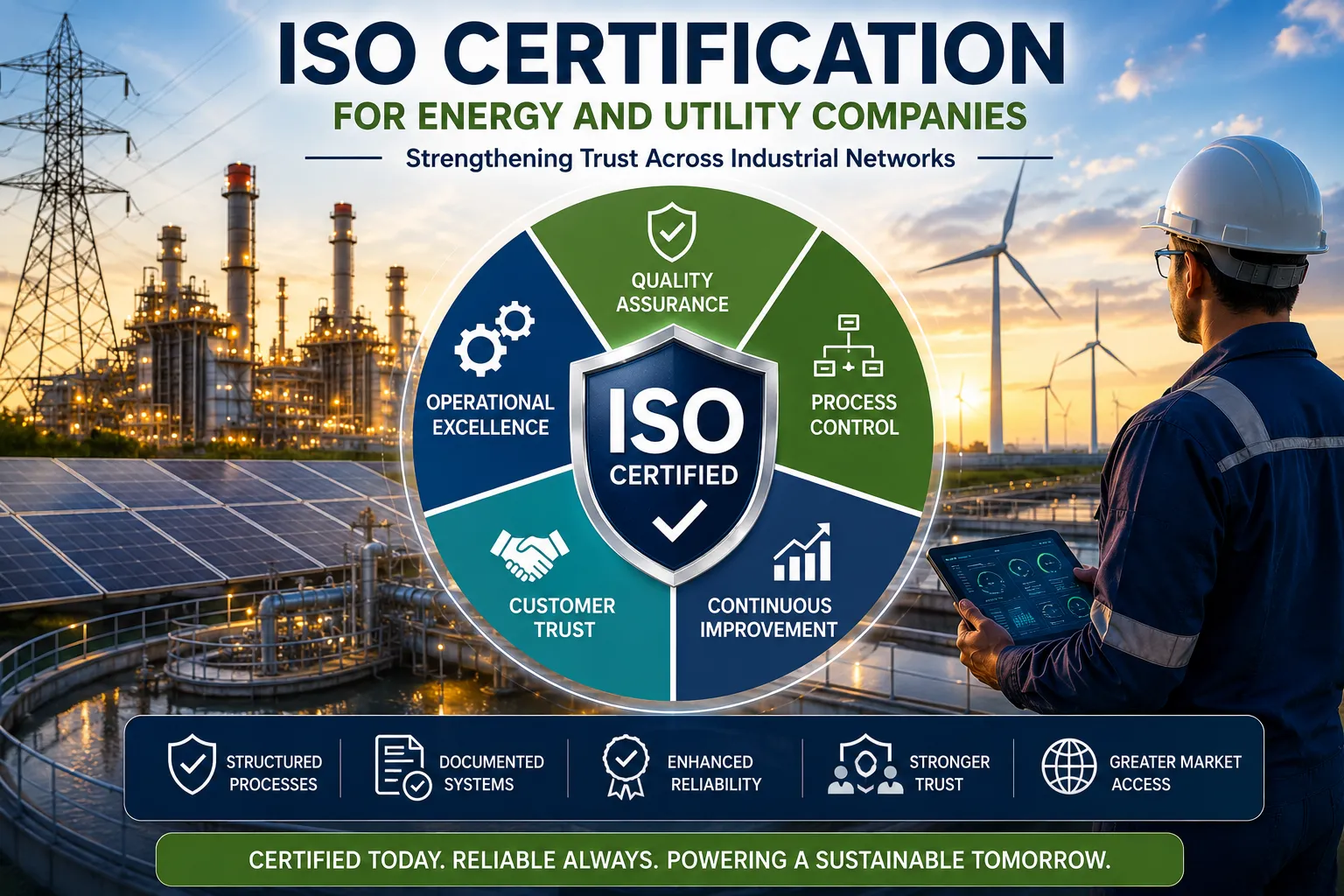
ISO Certification for Energy and Utility Companies Strengthening Trust Across Industrial Networks
By Jake Scott
118 Views
Why Energy and Utility Companies Are Looking Beyond Traditional Certifications
Energy and utility companies operate in an environment where reliability is not simply an expectation; it is the foundation of daily operations. Every process inside a utility organization depends on control, consistency, and confidence. Whether a company manages electricity generation, fuel processing, renewable energy operations, water systems, or industrial utilities, maintaining structured procedures has become increasingly important. Traditionally, these organizations focused heavily on operational certifications and technical standards directly connected to production and safety requirements. However, business conditions continue changing, and companies are beginning to recognize that broader certification systems can also contribute to growth and credibility.
ISO Certification may initially appear unrelated to energy and utility industries. Many people immediately connect ISO standards with manufacturing environments and quality systems used inside factories. That assumption is understandable because manufacturing sectors have historically represented one of the largest areas where ISO systems are discussed. Yet the industrial landscape is far more interconnected than many organizations realize. Energy providers support manufacturing facilities, industrial processing plants, chemical suppliers, infrastructure projects, and numerous sectors that increasingly require documented quality assurance systems. Because of these connections, energy companies are beginning to explore how ISO Certification can strengthen operational confidence and create additional business opportunities.
Understanding ISO Certification Beyond Traditional Industry Assumptions
The idea that ISO Certification belongs only within manufacturing environments can sometimes limit how organizations view its practical value. Here is the thing: certification often extends beyond direct production activities. Operational systems, quality procedures, process controls, documentation practices, and support functions all become important parts of broader industrial ecosystems.
Think about a manufacturing organization that produces products for global markets while following strict quality procedures and regulatory expectations. That company depends on multiple supporting systems including utility providers, infrastructure support, process management systems, and operational controls. If environments require documented consistency and quality management systems, suppliers and supporting organizations throughout the network may also need to satisfy similar expectations.
Energy companies function as critical links inside these industrial ecosystems. They support operations that demand reliability and documented quality processes. Because of this relationship, certification requirements can gradually extend through supply chains and influence organizations that previously believed they sat outside these discussions.
The process is somewhat similar to a connected utility network. A disruption in one section may create unexpected effects elsewhere. In the same way, documentation requirements and operational expectations can travel through supply networks much farther than many organizations initially expect.
Why Supply Chains Have Started Asking More Questions
Supply chains have become significantly more detailed than they were years ago. Businesses today want greater visibility into sourcing practices, operational procedures, process controls, and documentation systems. Customers increasingly ask questions regarding procedures, management systems, and certification status because they want confidence at every stage of operations.
Energy and utility companies frequently support industries with strict operational requirements. Pharmaceutical facilities, industrial processors, manufacturing plants, and specialized production environments often require documented systems designed to reduce uncertainty and improve consistency. Companies no longer want assumptions; they want evidence.
A few years ago, supplier relationships may have depended largely on pricing and delivery schedules. Today, discussions often include documentation reviews, compliance evaluations, process assessments, and certification requirements. Businesses want assurance that systems operate consistently and effectively.
This shift creates a practical reason for organizations to consider ISO Certification. Companies may discover that certification supports smoother supplier relationships while strengthening trust between partners and customers. It becomes easier to communicate reliability when documented systems already exist.
Interestingly, many organizations do not begin exploring certification because they planned to. Sometimes a customer asks a simple question regarding quality systems or certification status, and suddenly that topic becomes a major discussion inside organizational meetings.
The Relationship Between Process Control and Certification Systems
Energy companies understand process control better than almost anyone. Power generation facilities, utility networks, and industrial operations cannot function effectively without structured systems. Small deviations can create larger consequences if they remain unnoticed.
Certification systems operate with a similar philosophy.
Imagine a utility control room filled with monitoring systems displaying operational performance. Engineers continuously track information because stability matters. Procedures exist because consistency matters. Corrective actions exist because unexpected situations happen.
ISO Certification introduces another layer of organized thinking into operational activities. It creates defined procedures and encourages documented control measures. Instead of relying entirely on assumptions, organizations establish structured methods for maintaining consistency.
This does not mean organizations suddenly replace systems already in place. Rather, certification frequently complements operational frameworks that already exist within the business. Companies often discover that many documentation processes are already established and simply require refinement or stronger alignment.
There is an interesting contradiction here. Some organizations initially worry that certification creates additional complexity. Later they realize structured systems sometimes reduce confusion rather than create it.
Building Customer Confidence Through Documented Standards
Trust develops gradually, and maintaining it often requires significant effort. Energy and utility providers understand this reality because customers expect reliable performance continuously. Consumers rarely think about systems operating behind the scenes unless something stops working.
The same concept applies within business relationships.
Customers increasingly want suppliers capable of demonstrating documented quality systems and controlled procedures. They want confidence that operations remain consistent and that organizations take requirements seriously.
ISO Certification can support this confidence because it represents documented oversight and structured verification. Businesses appreciate transparency because transparency reduces uncertainty.
Imagine two suppliers offering similar services. One organization provides detailed documentation demonstrating controlled systems and certification support, while another offers only general assurances. Which organization creates stronger confidence?
The answer usually becomes clear quite quickly.
Documentation alone does not guarantee success, of course. Strong relationships still depend on communication, reliability, and performance. However, supporting these relationships with structured certification systems can strengthen credibility.
Market Access and Growing Business Opportunities
Organizations continuously search for opportunities to strengthen market presence and expand customer relationships. Energy and utility companies are no different. Growth frequently depends on adapting to changing customer expectations and industry conditions.
Certification can become a valuable business tool because certain customers and industries prefer working with documented systems. Access to specific markets may become easier when organizations already satisfy certification expectations.
International trade and global supply chains have increased these requirements even further. Companies working across multiple regions frequently encounter different operational expectations and customer preferences. Having recognized certification systems can simplify discussions and reduce barriers during business development activities.
Opportunities sometimes arrive unexpectedly. A company may pursue one project only to discover additional opportunities become available because existing certification systems already support customer expectations.
That possibility alone encourages many organizations to explore certification discussions more seriously.
Operational Consistency Matters More Than Companies Think
Consistency sounds simple until organizations attempt maintaining it across multiple facilities, departments, suppliers, and operational activities. Large energy companies frequently manage highly complex systems involving numerous teams and interconnected operations.
One department may focus on technical activities while another manages supplier relationships. Procurement teams coordinate with vendors. Maintenance teams manage infrastructure. Quality teams review documentation systems.
Without structured systems, information can become difficult to manage.
ISO Certification encourages organizations to examine operational activities more carefully and maintain stronger control over documented processes. It supports a culture where procedures remain clear and responsibilities become easier to understand.
Interestingly, consistency often creates benefits beyond immediate operational improvements. Employees may feel more confident because expectations become easier to follow. Customers may experience smoother communication because documentation becomes more organized.
Small improvements repeated consistently can eventually create significant results.
Why Energy Companies Should Consider ISO Certification
Many organizations initially question whether ISO Certification provides practical value within utility environments. That reaction makes sense because energy companies traditionally focus on infrastructure, operational efficiency, and performance indicators.
However, modern business environments involve more than technical output alone.
Energy providers increasingly interact with industries where documentation, quality systems, and operational verification influence purchasing decisions. Certification can support stronger supplier relationships while helping organizations communicate reliability more effectively.
Instead of viewing certification as additional administrative work, organizations can approach it as an opportunity to strengthen systems, improve operational confidence, and build credibility.
The business environment continues evolving. Customer expectations continue changing. Supply chains continue becoming more interconnected.
Organizations that prepare for these changes often place themselves in stronger positions than organizations waiting until customer requirements force immediate action.
Looking Ahead at a Changing Industrial Environment
Industrial networks continue becoming more interconnected every year. Energy and utility companies support manufacturing operations, processing facilities, and production systems that depend heavily on reliability and documented quality standards.
Because of this growing connection, certifications that once appeared relevant only within specific sectors are gradually influencing broader industries. ISO Certification represents one example of this shift.
Companies no longer operate independently within isolated markets. They function inside large operational networks where one requirement can influence many organizations across multiple levels of activity.
The future will likely bring greater emphasis on transparency, documented procedures, and customer confidence. Organizations capable of adapting to these expectations may discover new opportunities while strengthening existing relationships.
Sometimes business growth does not begin with major infrastructure investments or large operational changes. Sometimes it starts with a simple decision to strengthen trust and create confidence throughout the entire system.
Related Reading
Why Business & Finance is Transforming the Global Industry Landscape
Welcome to our in-depth exploration of Business & Finance. In an era defined...
Expert Insights: Navigating the Complex World of Business & Finance
Welcome to our in-depth exploration of Business & Finance. In an era defined...