NBFC Software: A Complete Guide to Managing Lending Operations
By Roopya
13 Views
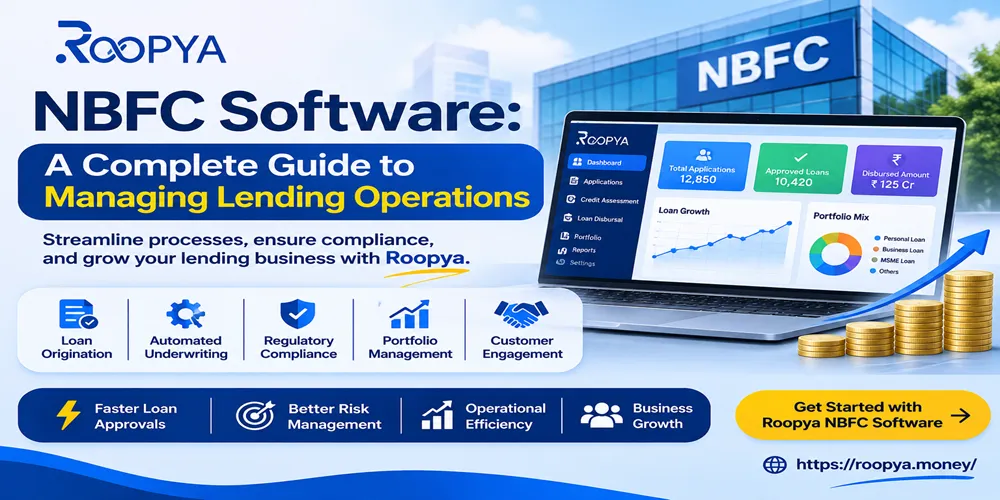
Non-Banking Financial Companies (NBFCs) have become the backbone of credit delivery in India, reaching borrowers that traditional banks often cannot serve efficiently. Micro, small and medium enterprises, gig workers, first-time borrowers in tier 2 and tier 3 cities, and thousands of small retailers depend on NBFCs for working capital, personal loans, vehicle finance and gold loans. As this sector grows, so does the complexity of running it. Spreadsheets, manual underwriting and disconnected systems simply cannot keep pace with rising loan volumes, tightening RBI compliance requirements and growing borrower expectations for instant, digital-first experiences.
This is where purpose-built NBFC software comes in. A modern lending technology stack brings origination, underwriting, disbursement, collections, accounting and regulatory reporting onto a single digital platform, letting NBFCs lend faster, reduce risk and scale without proportionally scaling headcount. This guide walks through what NBFC software actually does, the core modules every lender needs, the benefits of adopting it, how to choose the right platform, and what the future of lending technology looks like.
What Is NBFC Software?
NBFC software is a specialised technology platform designed to manage the complete lending lifecycle for non-banking financial companies. Unlike generic CRM or accounting tools, it is built around the specific regulatory, operational and risk requirements that apply to NBFCs registered with the Reserve Bank of India.
At its core, NBFC software typically combines several interconnected systems:
• A Loan Origination System (LOS) that captures applications, verifies documents and runs eligibility checks
• A Loan Management System (LMS) that tracks disbursed loans, EMI schedules, interest accrual and repayments
• A credit underwriting and scoring engine that evaluates borrower risk
• A collections and recovery module for managing overdue accounts
• Compliance and regulatory reporting tools aligned with RBI and credit bureau requirements
• Accounting and finance modules for ledger management, GST and financial statements
• Analytics and dashboards for portfolio monitoring and decision-making
Rather than operating as isolated tools, these modules work together as one connected system, so data entered at the origination stage flows automatically into servicing, collections and reporting, without manual re-entry or reconciliation errors.
Why NBFCs Need Dedicated Lending Software
Rising Loan Volumes and Shrinking Turnaround Times
Borrowers today expect loan decisions within minutes, not days. Manual processes that rely on physical paperwork, email-based approvals and spreadsheet tracking cannot support this expectation at any meaningful scale. Purpose-built software automates document verification, eligibility checks and approval workflows, compressing turnaround time from days to minutes in many cases.
Regulatory Complexity
NBFCs operate under a detailed and evolving regulatory framework set by the RBI, covering capital adequacy, asset classification, provisioning norms, fair practices codes and reporting formats such as NBS returns. Keeping track of these requirements manually increases the risk of non-compliance, penalties and reputational damage. Software with built-in compliance workflows reduces this burden significantly by automating classification, generating audit trails and producing regulator-ready reports.
Risk Management at Scale
As loan books grow, so does exposure to credit risk, operational risk and fraud. Without systemic checks, a growing NBFC can quickly lose visibility into portfolio quality. Lending software embeds credit scoring models, bureau integrations and rule-based underwriting into every application, ensuring consistent risk assessment regardless of loan volume or branch location.
Customer Experience Expectations
Borrowers increasingly compare their lending experience not just to other NBFCs, but to digital-first fintech apps and banks. A clunky, paper-heavy process drives customers toward competitors offering instant approvals, digital KYC and self-service loan tracking. Lending software closes this experience gap.
Core Modules of NBFC Software
1. Loan Origination System (LOS)
The loan origination module is the borrower's first touchpoint with the lender. It typically includes:
• Digital application forms with document upload
• e-KYC and Aadhaar-based verification
• Bank statement analysis and income verification
• Automated eligibility and affordability checks
• Configurable approval workflows with multi-level sign-off
• Integration with credit bureaus such as CIBIL, Experian, Equifax and CRIF High Mark
A strong LOS reduces manual data entry, flags incomplete applications early, and ensures every file that reaches an underwriter is complete and standardised.
2. Loan Management System (LMS)
Once a loan is disbursed, the loan management system takes over. It handles:
• EMI scheduling and amortisation calculations
• Interest accrual, including reducing balance and flat-rate methods
• Payment collection via NACH, UPI AutoPay and payment gateways
• Penalty and late fee computation
• Foreclosure, part-prepayment and restructuring workflows
• Real-time loan account statements for both staff and borrowers
This module is the operational heart of an NBFC's day-to-day business, and errors here directly affect revenue recognition, customer trust and regulatory reporting.
3. Credit Underwriting and Scoring Engine
Modern underwriting engines combine rule-based checks with statistical or machine-learning credit scoring models. These systems evaluate:
• Bureau score and credit history
• Repayment behaviour on existing loans
• Income stability and debt-to-income ratio
• Alternative data signals, such as utility payments or transaction history, for thin-file borrowers
Automated scoring reduces subjectivity in credit decisions, shortens turnaround time, and creates a defensible, auditable record of why each decision was made.
4. Collections and Recovery Management
Delinquency management is one of the highest-impact areas for NBFC profitability. A good collections module provides:
• Automated bucketing of overdue accounts (0-30, 31-60, 61-90 days, and beyond)
• Prioritised call lists and field-visit scheduling for collection agents
• SMS, WhatsApp and IVR-based payment reminders
• Digital payment links for instant repayment
• Legal and NPA tracking workflows for accounts that require escalation
Early identification of at-risk accounts, supported by automated nudges, materially reduces write-offs compared to manual, reactive collections.
5. Compliance and Regulatory Reporting
NBFC-specific compliance features typically include:
• Automated asset classification (standard, sub-standard, doubtful, loss) per RBI norms
• Provisioning calculations
• Fair Practices Code adherence tracking
• Generation of regulatory returns and statutory reports
• Audit trails for every loan decision and account change
6. Accounting and Financial Management
Integrated accounting modules ensure that every loan transaction automatically reflects in the general ledger, eliminating the reconciliation gap between operations and finance teams. This includes GST handling, interest income recognition, and financial statement preparation aligned with Indian Accounting Standards (Ind AS).
7. Analytics and Business Intelligence
Dashboards and reporting tools give management real-time visibility into portfolio quality, disbursement trends, branch-wise performance, collection efficiency and early-warning indicators, enabling faster, data-driven decisions.
Key Benefits of Implementing NBFC Software
Faster loan processing: Automation of document checks, eligibility rules and approval routing can cut loan processing time from days to under an hour for straightforward cases.
Reduced operational costs: Automating manual, repetitive tasks reduces the need for large back-office teams, letting NBFCs scale loan volumes without proportionally scaling staff.
Improved risk management: Standardised, rule-based underwriting reduces inconsistent decision-making and improves portfolio quality over time.
Regulatory confidence: Built-in compliance workflows reduce the risk of penalties, audit findings and reputational damage.
Better borrower experience: Digital applications, instant status updates and self-service repayment options meet rising customer expectations.
Scalability: Cloud-based lending platforms allow NBFCs to add new branches, products or loan categories without rebuilding core infrastructure.
Data-driven decision-making: Centralised data gives leadership accurate, real-time visibility into portfolio health, rather than relying on delayed, manually compiled reports.
How to Choose the Right NBFC Software
Selecting a lending platform is a long-term decision, since migrating core loan data later is costly and disruptive. Consider the following factors:
1. Regulatory Alignment
Confirm that the platform is built with Indian NBFC regulations in mind, including RBI asset classification norms, fair practices codes and statutory reporting formats, rather than a generic global lending tool adapted after the fact.
2. Configurability
Every NBFC has unique products, approval hierarchies and risk policies. Look for software that allows configuration of workflows, scoring rules and loan products without requiring custom code for every change.
3. Integration Capability
The platform should integrate smoothly with credit bureaus, payment gateways, e-KYC providers, accounting systems and communication channels like SMS and WhatsApp, through well-documented APIs.
4. Scalability and Cloud Readiness
As loan books and branch networks grow, the system should scale without performance degradation, ideally on a cloud-native architecture that supports elastic scaling.
5. Security and Data Protection
Given the sensitivity of financial and personal data, the platform must support encryption, role-based access control, detailed audit logs and compliance with data protection requirements.
6. Vendor Support and Track Record
Evaluate the vendor's experience specifically with NBFCs, their implementation track record, ongoing support responsiveness and product roadmap.
7. Total Cost of Ownership
Look beyond the licence fee to implementation costs, integration charges, training, and ongoing maintenance to understand the true cost over several years.
Implementation Best Practices
Successful rollout of NBFC software typically follows a structured path:
1. Map existing processes before configuring the system, so workflows reflect how the business actually operates, not just how the software is designed by default.
2. Migrate data carefully, with reconciliation checks between the old system and new platform before go-live.
3. Run a parallel phase, processing a subset of loans on both old and new systems to validate accuracy.
4. Train staff thoroughly, since even the best software underperforms if underwriters, collections staff and branch teams are not comfortable using it.
5. Start with one branch or product line, then expand once the system is proven, rather than a simultaneous company-wide switch.
6. Review and refine underwriting rules and workflows periodically based on real portfolio performance data.
The Future of NBFC Lending Technology
Lending technology continues to evolve quickly, and a few trends are shaping what NBFC software will look like over the next few years:
AI-driven underwriting: Machine learning models are increasingly used to assess creditworthiness using alternative data, improving access to credit for thin-file borrowers while managing risk.
Embedded finance and co-lending: Growing partnerships between NBFCs, banks and fintech platforms require software that supports co-lending arrangements, split disbursements and shared risk models.
Open banking and API ecosystems: Account aggregator frameworks and open banking APIs are making real-time, consent-based financial data access standard practice in underwriting.
Hyper-personalisation: Borrowers increasingly expect loan products, pricing and communication tailored to their individual profile rather than one-size-fits-all offerings.
Predictive collections: Instead of reacting to missed payments, predictive models are helping lenders identify at-risk accounts before they become delinquent.
Conclusion
As India's NBFC sector continues to expand, the gap between lenders running on modern, connected technology and those relying on manual processes and spreadsheets will only widen. The right NBFC software does more than digitise paperwork, it fundamentally changes how fast an NBFC can lend, how accurately it can assess risk, and how confidently it can demonstrate regulatory compliance.
Choosing a platform purpose-built for NBFC operations, rather than adapting generic tools, gives lenders a foundation that can scale with their ambitions. Whether you are a new NBFC setting up your first digital lending stack or an established lender looking to replace legacy systems, the investment in the right technology pays back through faster growth, lower risk and better borrower experience.
To see how a purpose-built lending platform can support your NBFC's origination, underwriting, collections and compliance needs end to end, explore what Roopya offers at roopya.money.
Frequently Asked Questions (FAQ)
1. What is NBFC software used for?
NBFC software is used to manage the complete lending lifecycle, including loan origination, underwriting, disbursement, EMI collection, delinquency management, accounting and RBI-aligned regulatory reporting, all from a single connected platform.
2. Is NBFC software different from banking software?
Yes. While both manage lending operations, NBFC software is specifically designed around RBI regulations that apply to non-banking financial companies, such as NBFC-specific asset classification norms and reporting formats, which differ from standard banking compliance requirements.
3. Can small or new NBFCs afford dedicated lending software?
Yes. Most modern NBFC software is offered on a cloud-based, subscription model, which significantly lowers upfront investment compared to building or buying on-premise systems, making it accessible for smaller and newly licensed NBFCs.
4. How long does it take to implement NBFC software?
Implementation timelines vary based on the complexity of existing processes and data migration needs, but a phased rollout starting with one branch or loan product typically allows NBFCs to go live within a few weeks to a few months.
5. Does NBFC software help with RBI compliance?
Yes. Purpose-built NBFC software automates asset classification, provisioning calculations and the generation of regulatory returns, reducing the manual effort and error risk involved in staying compliant with RBI norms.
6. What is the difference between a Loan Origination System (LOS) and a Loan Management System (LMS)?
An LOS manages the borrower's journey from application through approval and disbursement, while an LMS takes over after disbursement to manage EMI schedules, repayments, interest accrual and loan servicing until closure.
7. Can NBFC software integrate with credit bureaus and payment gateways?
Yes. Most modern NBFC platforms offer API-based integrations with credit bureaus such as CIBIL and CRIF High Mark, as well as payment gateways, UPI AutoPay, NACH and e-KYC providers, enabling end-to-end digital workflows.
8. What should an NBFC look for before choosing lending software?
Key considerations include regulatory alignment with RBI norms, configurability of workflows and products, integration capability, scalability, data security, vendor track record, and total cost of ownership beyond the initial licence fee.
Related Reading
Why Business & Finance is Transforming the Global Industry Landscape
Welcome to our in-depth exploration of Business & Finance. In an era defined...
Expert Insights: Navigating the Complex World of Business & Finance
Welcome to our in-depth exploration of Business & Finance. In an era defined...