Category

Technology & IT

Comprehensive discussions and expert insights revolving around technology & it trends and best practices.

May 25, 2026 128 Reads

Why Test Automation Services Decide Long-Term Software Reliability Today

When Software Stops Being Just About FeaturesMost teams don’t think about reliability until something breaks. Not a full crash, just something small that slips through. A workflow that doesn’t complete properly. A report that looks fine but isn’t.That’s usually the quiet beginning of bigger problems.And this is where test automation services start to matter more than people expect. Not for speed. Not for trends. But for long-term stability.Because software doesn’t fail all at once. It drifts. Slowly. Until users notice.Teams using tools like Worksoft usually catch that drift earlier. Not because they’re over-testing, but because they’re testing consistently.What Test Automation Services Actually Do in Simple TermsIf you strip away the technical talk, it’s simple.Test automation services run software tests automatically instead of relying on manual repetition every release.Same steps. Same flows. Same validation. Every time.But the real value isn’t just automation. It’s repeatability under pressure.Humans change how they test. Sometimes they skip steps. Sometimes they rush. Automation doesn’t.And in long-term systems, that consistency matters more than anything else.Especially when workflows span multiple systems, which is exactly where Worksoft comes in with business-process-level testing.Why Long-Term Software Breaks SilentlyThe worst bugs aren’t the ones that crash systems. They’re the ones that don’t look like bugs at first.A calculation is slightly off. A status doesn’t update correctly. A process completes but misses one step.Everything still “works”… until someone investigates deeper.That’s what makes long-term reliability tricky.Manual testing rarely catches these consistently because it’s hard to repeat everything exactly the same way every time.Test automation services remove that inconsistency. They run identical checks across every release.No memory gaps. No skipped flows.Where Worksoft Fits Into Real Enterprise StabilityWorksoft focuses on something a bit different than traditional testing tools.It doesn’t just test isolated functions. It focuses on full business processes.That’s important because most real-world systems aren’t isolated. They’re connected. Finance, HR, supply chain, CRM all talking to each other.And when one step breaks in a long chain, the issue often shows up somewhere completely unrelated.Worksoft helps validate those end-to-end flows without needing heavy scripting.That’s why enterprise teams lean on it for test automation services. Not because it’s simple, but because it reflects how real systems behave.The Hidden Benefit: Fewer Surprises Over TimePeople usually talk about automation in terms of speed.But speed isn’t the real payoff.The real payoff is fewer surprises.When test automation services are running properly, teams stop getting shocked by production issues. They already know what’s been tested. They already know what changed.That removes a lot of uncertainty from release cycles.And over time, something interesting happens. Teams become calmer. Releases feel less risky.Not perfect. Just controlled.That shift is bigger than it sounds.Why Automation Fails When It’s RushedAutomation sounds easy in theory. Just run tests automatically, right?But in practice, it gets messy fast.Teams try to automate too much too quickly. Or they automate unstable workflows. Or they don’t define processes clearly before building tests.Then maintenance becomes harder than manual testing ever was.Even tools like Worksoft can’t fix unclear processes. They just scale whatever structure you give them.So the smarter approach is slower. Focus on core workflows first. Stabilize. Then expand.It’s not exciting. But it lasts longer.Why Business Process Thinking Matters More Than ToolsA lot of testing focuses on features.Does this button work? Does this API respond correctly?But real systems don’t fail at the feature level.They fail in flow.Test automation services that focus on business processes catch issues that feature-based testing misses completely.Because they validate how systems behave across multiple steps, not just inside one function.That’s where Worksoft fits naturally. It doesn’t just test parts. It tests outcomes.And outcomes are what users actually care about.How Teams Quietly Change After Automation Is IntroducedOnce test automation services become stable, something subtle shifts in teams.Testing is no longer a bottleneck. It becomes background infrastructure.QA teams stop reacting to every change like it’s a risk event. Developers stop worrying about last-minute surprises.Everything feels more predictable.Not faster. Not flashy. Just smoother.And that smoothness changes how releases are planned, discussed, and executed.It becomes less stressful without anyone really announcing it.Conclusion: Reliability Comes From Repetition, Not GuessworkLong-term software reliability isn’t built in one big moment.It’s built through repetition. Same tests. Same flows. Every time the system changes.That’s what test automation services actually bring into the picture. Consistency over chaos.And tools like Worksoft help make that repeatability practical in real enterprise environments where complexity is unavoidable.It’s not about eliminating problems completely.It’s about making sure problems don’t stay hidden.Because in software, the quiet ones are always the ones that matter most.FAQsWhat are test automation services in software testing?They are services that automate repetitive test cases to ensure consistent and reliable software validation across releases.Why are test automation services important for long-term reliability?They reduce human error and ensure consistent testing over time, helping detect issues early before they reach production.How does Worksoft support test automation services?Worksoft provides codeless, business-process-based automation designed for complex enterprise systems.Do test automation services replace manual testing?No, manual testing is still useful for exploratory and edge-case scenarios.When should companies invest in test automation services?When systems become complex, release cycles increase, or manual regression testing becomes too slow or unreliable.

B
Ben Richards
May 19, 2026 140 Reads

IEE Citation Generator: Smarter Referencing for Modern Academic Writing

What an IEE Citation Generator Actually DoesAn iee citation generator is a digital tool that automatically creates references in the IEEE (Institute of Electrical and Electronics Engineers) citation style. This style is widely used in engineering, computer science, robotics, and technical research papers.Instead of manually formatting every book, journal, or website reference, students and researchers can use an IEE citation generator to produce correctly structured citations in seconds. It removes the repetitive formatting work and helps writers focus more on research and ideas.At its core, it is not just a convenience tool—it is a time-saver for structured academic communication.Why IEEE Citation Style Matters in ResearchThe IEEE referencing system is known for its numbered citation format, which keeps academic writing clean and organized. Each source is assigned a number in the order it appears in the text, making technical documents easier to read.An iee citation generator helps maintain this structure without manual errors, ensuring consistency across long research papers.This is especially important in fields where precision is critical, such as:Electrical engineeringArtificial intelligence researchComputer science documentationTelecommunications studiesRobotics and automation reportsHow an IEE Citation Generator Works Behind the ScenesAlthough it looks simple on the surface, a citation generator follows structured rules to format academic references correctly.Input Data CollectionUsers enter details such as author name, title, publication year, journal name, or URL.Formatting EngineThe tool applies IEEE rules to arrange the information in the correct sequence.Output GenerationIt produces a properly formatted citation that can be directly used in academic writing.Reference Number AssignmentIn IEEE style, citations are numbered based on their appearance in the document, and the generator helps maintain this order.See more:  citation generatorKey Benefits of Using an IEE Citation GeneratorModern researchers and students rely on citation tools for efficiency and accuracy.Saves Time in Academic WritingManually formatting references can take hours. A citation generator reduces this to seconds.Reduces Formatting ErrorsIEEE style has strict rules, and small mistakes can affect credibility. Automation ensures precision.Improves Research ProductivityWriters can focus more on content creation rather than formatting references.Supports Multiple Source TypesAn iee citation generator can handle books, websites, research papers, conference proceedings, and more.Common Mistakes the Tool Helps AvoidEven experienced writers sometimes make errors when citing manually.Incorrect Order of InformationIEEE citations require a specific sequence of details, which generators automatically manage.Missing Publication DetailsImportant elements like volume numbers or publisher names are often overlooked manually.Inconsistent FormattingDifferent sources may lead to inconsistent styles without automation.Where IEEE Citation Generators Are Most UsefulThese tools are widely used in academic and professional environments.University Research PapersStudents use them to ensure compliance with strict formatting guidelines.Engineering ProjectsTechnical documentation requires accurate referencing for validation and credibility.Scientific JournalsResearchers depend on citation accuracy for peer-reviewed publications.Online Learning and AssignmentsEven beginners benefit from structured referencing in coursework and reports.Limitations of an IEE Citation GeneratorWhile powerful, these tools are not perfect and still require human supervision.Input DependencyIf incorrect data is entered, the output citation will also be incorrect.Style VariationsDifferent institutions may slightly modify IEEE rules, requiring manual adjustments.Lack of Context UnderstandingA generator formats data but does not understand the research itself.The Future of Citation AutomationThe evolution of citation tools is moving toward smarter academic assistants. Future iee citation generator systems may include:Direct integration with research databasesAI-powered auto-extraction of citation data from PDFsReal-time formatting inside writing softwareCross-style conversion between IEEE, APA, and MLAThese improvements will make academic writing even more seamless and efficient.Conclusion: Making Academic Writing More EfficientAn iee citation generator is more than just a formatting tool—it is a bridge between research and presentation. It helps maintain accuracy, saves valuable time, and ensures consistency in academic writing.As research continues to grow in complexity, tools like these will remain essential for students, engineers, and scientists who want to focus on ideas rather than formatting rules.See more blogs: Visit Here

s
sungrow battery
May 18, 2026 137 Reads

Sales Compensation Automation Using CRM Systems

Sales compensation is one of the strongest drivers of sales behavior. A clear plan pushes sales reps toward the right targets. A weak plan creates confusion, disputes, and poor motivation. Many companies still manage commissions through spreadsheets, emails, and manual approvals. That approach works for a small team, but it breaks quickly as sales volume grows.Modern CRM systems make this process more accurate and transparent. They capture deal values, sales stages, ownership, close dates, and customer records. When connected with workflow and finance tools, CRM data can support faster commission calculations. For example, companies using ServiceNow Salesforce Integration can improve data movement between sales and service workflows, which helps reduce manual transfer errors. ServiceNow describes its Salesforce Integration Spoke as a bridge for automated data transfer and data consistency between both platforms.What Is Sales Compensation Automation?Sales compensation automation means using software to calculate, track, approve, and report commissions. Instead of finance teams checking every deal manually, the system applies predefined rules. These rules can include commission rates, quotas, bonuses, territories, and product incentives.The CRM becomes the main data source. It tells the system who closed the deal, when it closed, and how much it was worth. Then the compensation tool calculates the payout based on the plan. Salesforce explains that incentive compensation software uses CRM and sales performance data to automate commission calculations.This matters because compensation is sensitive. If a rep feels underpaid, trust drops fast. If finance pays too much, profit suffers. Automation helps both sides by making the process clearer and easier to audit.Why Manual Sales Compensation Creates ProblemsManual commission tracking looks simple at first. A manager adds closed deals to a spreadsheet. Finance checks the numbers. Then payroll processes the payout. But the problem starts when plans become more complex.A business may have different commission rates by product, region, team, or deal size. Some reps may earn bonuses after reaching quota. Others may receive tiered payouts. In many companies, commission depends on payment collection, not just deal closure.Spreadsheets are not built for this level of complexity. One wrong formula can create wrong payouts. One outdated file can trigger disputes. One missing approval can delay the whole payroll cycle.The real cost is not only financial. Sales reps lose focus when they keep asking about commissions. Managers waste time solving payout conflicts. Finance teams get stuck in repetitive checking. Everyone becomes slower.How CRM Systems Support Compensation AutomationCRM systems support compensation automation by creating a reliable sales data layer. They record every major sales activity. This includes leads, opportunities, accounts, deal owners, product lines, and sales stages.Salesforce says Sales Cloud helps sales teams sell more efficiently through one integrated platform. It also supports automation, dashboards, and sales management workflows. These features are useful because commission plans depend on clean sales records.A CRM can also define when a deal becomes commissionable. For example, a company may only pay commission when a deal is marked “closed-won.” Another company may require invoice payment first. These rules can be mapped inside the CRM or connected compensation software.This is where automation becomes powerful. The system does not need someone to copy deal data manually. It pulls the correct information from the CRM. Then it applies the compensation logic consistently.How Sales Compensation Automation WorksThe process usually starts with sales data collection. The CRM stores deal size, close date, customer name, sales rep, and product category. It may also track payment status, contract length, and account type.Next, the company sets compensation rules. These rules define how commissions are earned. A simple plan may pay five percent on every closed deal. A more advanced plan may pay different rates after quota achievement.Then the software calculates commission automatically. It checks the CRM record and applies the correct formula. If the rep qualifies for a bonus, the system adds it. If the deal is not eligible, the system excludes it.After that, managers or finance teams review the payout. This approval step is important. Automation should reduce manual work, not remove control completely.Finally, reports are generated for payroll and leadership. Sales reps can also view their expected earnings. This improves trust because they can see how each payout was calculated.Types of Compensation Plans That Can Be AutomatedMany businesses assume automation only works for simple commissions. That is not true. A strong CRM-based system can support several compensation models.The most common model is salary plus commission. Reps receive a fixed salary and extra commission on sales. Another model is straight commission, where income depends fully on closed deals.Tiered commission is also common. A rep may earn five percent before quota and eight percent after reaching quota. This rewards strong performers without changing the base structure.Quota-based bonuses are another useful option. For example, a rep may receive a bonus after reaching 100 percent of target. Some companies also use product-specific incentives to push strategic products.Team-based incentives can also be automated. This works well when sales, account management, and customer success share revenue responsibility. However, the rules must be very clear.Benefits for Sales TeamsFor sales reps, the biggest benefit is visibility. They can see their expected commission before payday. This reduces anxiety and improves motivation.Automation also reduces disputes. When the system shows the deal, rule, rate, and payout, arguments become easier to solve. Reps no longer need to chase managers for updates.It also helps reps plan better. If they know how close they are to a bonus, they can prioritize stronger opportunities. That creates better selling behavior.Here is the brutal truth. Salespeople do not only work for praise. They work for clear rewards. If the reward system feels unfair, performance will suffer.Benefits for Managers and Finance TeamsManagers gain better control over sales performance. They can see who is close to quota, who is underperforming, and who deserves coaching. CRM dashboards make this easier to track.Finance teams save time because they no longer rebuild commission reports from scratch. Salesforce Spiff notes that compensation software can reduce errors, improve transparency, and save administrative time.Automation also improves audit readiness. Every payout has a data trail. Leaders can review which deal created which commission. This helps during internal reviews and financial checks.For business owners, the benefit is strategic. Compensation becomes a performance system, not just a payroll task. That shift can improve revenue quality.Key Features to Look ForA good compensation automation setup should include flexible rule creation. Your business should be able to define rates, quotas, bonuses, and exceptions without heavy coding.Real-time dashboards are also important. Sales reps need visibility into earnings. Managers need visibility into team performance. Finance needs visibility into upcoming payout obligations.Approval workflows matter too. The system should allow managers to review payouts before payroll. This keeps control in place.Audit trails are another must-have feature. Every calculation should be traceable. If a rep questions a payout, the company should answer with evidence.Integration is equally important. The system should connect with CRM, payroll, finance, and ERP tools. Salesforce says incentive compensation software should integrate with existing systems and provide reporting insights.CRM Integration with Compensation Management ToolsSome CRM platforms include compensation-related features. Others work better when connected with dedicated commission tools. Examples include Salesforce Spiff, Xactly, CaptivateIQ, Performio, and Everstage.The CRM should remain the source of truth for sales activity. The compensation platform should manage complex payout logic. This separation keeps the system cleaner.However, integration quality matters. If CRM data is incomplete, automation will produce poor results. Bad input still creates bad output. This is the part many companies ignore.Before buying software, businesses should clean their CRM fields. Deal ownership, product categories, close dates, and payment status must be accurate. Otherwise, automation only makes mistakes faster.Common Challenges and RisksThe first challenge is poor CRM data quality. If reps do not update opportunities correctly, commission calculations become unreliable. This problem is not technical. It is operational.The second challenge is overcomplicated compensation design. Some companies create plans with too many exceptions. Then they expect software to fix the confusion. That is weak thinking.The third challenge is lack of training. Sales reps need to understand how commissions are calculated. Managers need to understand how approvals work. Finance needs to know how exceptions are handled.Security is another concern. Compensation data is sensitive. Access should be role-based. Not everyone should see everyone else’s earnings.There is also a cultural risk. If automation is introduced badly, reps may fear losing control. Companies should explain that automation improves fairness and visibility.Best Practices for Successful ImplementationStart by simplifying the compensation plan. Remove unnecessary exceptions. Make the plan easy enough for a sales rep to explain in two minutes.Next, define commissionable events clearly. Decide whether commission starts after deal closure, invoice generation, or payment collection. This one decision prevents many disputes.Then clean the CRM data. Standardize fields, ownership rules, product categories, and deal stages. Do this before automation begins.After that, test the system with historical deals. Compare automated calculations against previous manual payouts. Fix errors before launch.Train every stakeholder. Sales teams should know how to read dashboards. Managers should know how to approve payouts. Finance should know how to audit records.Finally, review the plan regularly. Markets change, products change, and sales targets change. Your compensation plan should evolve too.Practical Business Use CaseImagine a software company with 30 sales reps. Each rep has a monthly quota. The company pays five percent commission below quota and eight percent after quota. It also pays a bonus for annual contracts.Before automation, finance spends five days every month checking commissions. Sales reps regularly dispute missing deals. Managers waste time confirming numbers.After CRM-based automation, closed-won deals flow into the compensation system. The software checks quota progress and contract type. Then it calculates the correct payout.Managers review exceptions only. Finance exports approved payouts for payroll. Reps can see their expected earnings through dashboards.The result is simple. Less manual work. Fewer disputes. Faster payouts. Better trust.Future of Sales Compensation AutomationSales compensation automation is moving toward smarter decision-making. AI can help detect unusual payout patterns. It can also highlight reps who may miss quota.Future systems may suggest better quota structures. They may also recommend incentive changes based on sales behavior. Salesforce describes Sales Cloud as an AI-powered platform for pipeline visibility, forecasting, and automation.However, AI will not replace compensation strategy. Leaders still need judgment. A machine can calculate payouts. It cannot decide what behavior your business should reward.This is where strong companies will win. They will combine clean CRM data, simple compensation rules, and smart automation. Weak companies will automate messy processes and blame the tools.ConclusionSales compensation automation using CRM systems helps businesses improve accuracy, speed, and transparency. It reduces spreadsheet errors and gives sales reps better visibility into earnings. It also helps managers and finance teams save time.But automation is not magic. It only works when the compensation plan is clear and CRM data is clean. A confusing plan will stay confusing, even with expensive software.The best approach is practical. Simplify the plan first. Clean the CRM second. Automate the workflow third. Then monitor results and improve the system over time.For growing sales teams, this is not just an operational upgrade. It is a trust-building system. When reps trust the compensation process, they focus more on selling. That is where the real business value starts

M
MichaelLukacs
May 15, 2026 141 Reads

Water Quality Meter: A Modern Tool for Safe and Clean Water

Water is one of the most essential resources for life. Humans, animals, industries, and agriculture all depend on clean and safe water for survival and growth. However, water pollution has become a major concern around the world due to industrial waste, agricultural chemicals, sewage discharge, and environmental contamination. To ensure that water remains safe for drinking, farming, and industrial use, accurate testing methods are necessary. One of the most effective devices used for this purpose is the water quality meter.A water quality meter is a scientific instrument designed to measure different properties of water. It helps determine whether water is safe, contaminated, or suitable for a specific application. These meters are widely used in homes, laboratories, industries, water treatment plants, fisheries, and environmental monitoring systems. By providing accurate and quick readings, water quality meters play an important role in maintaining public health and protecting ecosystems.Understanding Water QualityWater quality refers to the physical, chemical, and biological characteristics of water. Good quality water should be free from harmful substances, microorganisms, and pollutants. Several factors influence water quality, including pH level, temperature, dissolved oxygen, turbidity, conductivity, and total dissolved solids (TDS).Contaminated water can lead to serious health problems such as diarrhea, cholera, skin infections, and other waterborne diseases. Poor water quality can also damage crops, affect industrial processes, and harm aquatic life. Therefore, monitoring water quality regularly is essential for ensuring safety and sustainability.What Is a Water Quality Meter?A water quality meter is an electronic device used to analyze and measure water parameters. These devices can range from simple handheld meters to advanced multiparameter systems capable of testing several factors at the same time. The meter collects data through sensors and displays the results digitally.Modern water quality meters are designed for ease of use and high accuracy. They are portable, efficient, and suitable for both professional and personal applications. Depending on the model, a water quality meter can measure one parameter or multiple parameters simultaneously.Important Parameters MeasuredpH LevelThe pH level measures how acidic or alkaline water is. A pH value below 7 indicates acidic water, while a value above 7 indicates alkaline water. Neutral water has a pH of 7. Drinking water generally requires a balanced pH to remain safe and pleasant in taste. Extreme pH levels can corrode pipes, damage equipment, and affect human health.Total Dissolved Solids (TDS)TDS refers to the amount of dissolved substances in water, including salts, minerals, and metals. High TDS levels may indicate contamination or excessive mineral content. TDS meters are commonly used in homes, aquariums, and water purification systems.ConductivityConductivity measures the ability of water to conduct electricity. This property depends on the concentration of ions present in the water. Conductivity testing helps determine water purity and detect pollutants.Dissolved Oxygen (DO)Dissolved oxygen is essential for aquatic organisms such as fish and plants. Low oxygen levels can harm marine ecosystems and indicate pollution. Water quality meters with DO sensors are frequently used in fisheries and environmental studies.TurbidityTurbidity measures the cloudiness of water caused by suspended particles such as dirt, algae, and sediments. High turbidity can reduce water quality and indicate contamination. Clean drinking water should have low turbidity levels.TemperatureWater temperature affects chemical reactions, oxygen levels, and aquatic life. Many water quality meters include temperature sensors because accurate readings often depend on temperature conditions.Types of Water Quality MetersPortable Water Quality MetersPortable meters are compact and easy to carry. They are commonly used for field testing, environmental surveys, and household applications. Their portability allows users to test water quickly in different locations.Benchtop Water Quality MetersThese meters are larger and designed for laboratory use. They provide highly accurate results and are suitable for scientific research and industrial testing.Multiparameter MetersMultiparameter meters can measure several water properties at the same time. These advanced devices save time and improve efficiency, especially in industrial and environmental applications.Digital Smart MetersModern smart meters often include Bluetooth connectivity, data storage, and smartphone integration. These features make monitoring and record-keeping more convenient.Applications of Water Quality MetersDrinking Water TestingWater quality meters are commonly used to ensure drinking water safety. Municipal authorities, laboratories, and homeowners use these devices to detect contamination and verify purification systems.Industrial UseIndustries require high-quality water for manufacturing, cooling, and cleaning processes. Water quality meters help maintain standards and protect machinery from damage caused by poor water conditions.AgricultureFarmers use water quality meters to test irrigation water. Proper water quality is important for healthy crop growth and soil management.Aquaculture and FisheriesFish farms and aquariums rely on balanced water conditions for aquatic life. Monitoring dissolved oxygen, pH, and temperature helps maintain healthy environments for fish and plants.Environmental MonitoringEnvironmental agencies use water quality meters to monitor rivers, lakes, and oceans. These measurements help identify pollution sources and support conservation efforts.Swimming Pools and SpasPool owners use water quality meters to maintain safe and clean water conditions. Proper chemical balance prevents skin irritation and bacterial growth.Benefits of Using Water Quality MetersOne of the major advantages of water quality meters is accuracy. These devices provide precise readings, helping users make informed decisions about water treatment and usage. Quick testing is another benefit, as results are often available within seconds.Water quality meters also improve safety by detecting harmful contaminants early. Regular monitoring helps prevent health risks and environmental damage. In industrial settings, these meters reduce maintenance costs by protecting equipment from corrosion and scaling.Additionally, portable meters make testing convenient and accessible. Users can easily carry the device and perform tests on-site without requiring a laboratory.Challenges and LimitationsDespite their benefits, water quality meters also have some limitations. Some advanced meters can be expensive, making them less affordable for small users. Sensors require regular calibration and maintenance to ensure accurate readings.Environmental conditions such as temperature changes and contamination on sensors can affect measurement accuracy. Users must also understand how to interpret readings correctly to avoid incorrect conclusions.Another challenge is that no single meter can detect every possible contaminant. Certain biological or chemical pollutants may require specialized laboratory testing.Future of Water Quality MonitoringTechnology is continuously improving water quality monitoring systems. Modern devices are becoming more compact, accurate, and user-friendly. Smart sensors and wireless monitoring systems allow real-time data collection and remote monitoring.Artificial intelligence and cloud computing are also being integrated into water quality systems. These technologies help analyze large amounts of data, identify pollution trends, and improve decision-making.In the future, affordable and advanced water quality meters may become common household devices, allowing people to monitor water safety regularly and easily.ConclusionWater quality meters are valuable tools for ensuring safe and clean water in homes, industries, agriculture, and environmental systems. By measuring important parameters such as pH, dissolved oxygen, conductivity, and TDS, these devices help detect contamination and maintain water standards.

S
Sail Mehboob
May 14, 2026 137 Reads

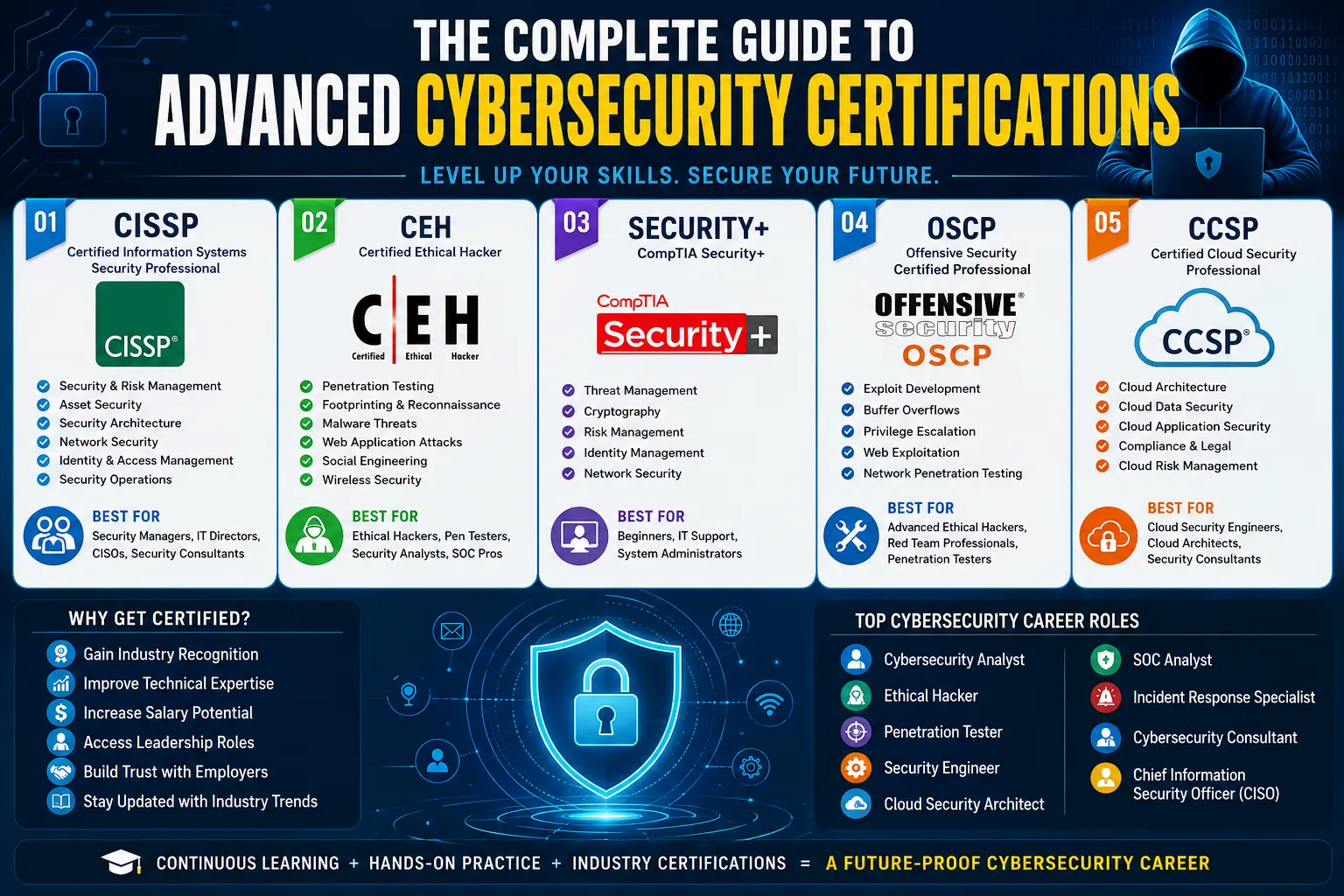
The Complete Guide to Advanced Cybersecurity Certifications

In today’s digital-first world, cybersecurity has become one of the most in-demand and high-paying career fields globally. From protecting sensitive business data to preventing ransomware attacks, cybersecurity professionals play a critical role in securing organizations against evolving cyber threats. As cyberattacks become more sophisticated, companies now prefer skilled professionals with advanced certifications that validate real-world expertise.Whether you are an IT professional, ethical hacker, security analyst, or beginner planning to enter the cybersecurity industry, earning advanced cybersecurity certifications can significantly improve your career opportunities, salary potential, and industry credibility.In this complete guide, we will explore the best advanced cybersecurity certifications, their benefits, eligibility, career scope, and how to choose the right certification for your goals.Why Advanced Cybersecurity Certifications MatterCybersecurity certifications are more than just credentials. They demonstrate your practical knowledge, technical skills, and commitment to continuous learning in a rapidly changing industry.Organizations today face threats such as:Ransomware attacksData breachesCloud security vulnerabilitiesPhishing scamsInsider threatsAI-powered cyberattacksBecause of these challenges, companies actively look for certified cybersecurity professionals who can secure networks, applications, and cloud environments effectively.Advanced certifications help professionals:Gain industry recognitionImprove technical expertiseIncrease salary potentialAccess leadership rolesBuild trust with employersStay updated with modern security practicesTop Advanced Cybersecurity Certifications in 20261. Certified Information Systems Security Professional (CISSP)The CISSP certification is one of the most respected cybersecurity credentials worldwide. It is ideal for experienced security professionals who want leadership or managerial roles.Key Skills Covered:Security and risk managementAsset securitySecurity architectureNetwork securityIdentity and access managementSecurity operationsBest For:Security ManagersSecurity ConsultantsChief Information Security Officers (CISO)IT DirectorsCareer Benefits:Professionals with CISSP certification often secure high-paying roles in multinational companies and government organizations.2. Certified Ethical Hacker (CEH)The CEH certification focuses on ethical hacking techniques used to identify vulnerabilities before malicious hackers exploit them.Topics Included:Penetration testingFootprinting and reconnaissanceMalware threatsWeb application attacksSocial engineeringWireless securityBest For:Ethical HackersPenetration TestersSecurity AnalystsSOC ProfessionalsThis certification is highly popular among students searching for a practical cybersecurity certification course that provides hands-on exposure to ethical hacking tools and techniques.3. CompTIA Security+CompTIA Security+ is considered one of the best foundational-to-intermediate cybersecurity certifications. It is globally recognized and suitable for beginners transitioning into cybersecurity roles.Skills Covered:Threat managementCryptographyRisk managementIdentity managementNetwork securityIdeal For:Beginners in cybersecurityIT support professionalsSystem administratorsWhy It’s Valuable:Security+ helps candidates build a strong foundation before pursuing advanced certifications like CISSP or OSCP.4. Offensive Security Certified Professional (OSCP)OSCP is one of the most technically challenging certifications in cybersecurity. It focuses heavily on real-world penetration testing skills.What Makes OSCP Unique?Unlike theory-based exams, OSCP requires candidates to hack into live systems during the exam.Skills Covered:Exploit developmentBuffer overflowsPrivilege escalationWeb exploitationNetwork penetration testingBest For:Advanced ethical hackersRed team professionalsPenetration testersProfessionals holding OSCP certifications are highly respected in the cybersecurity community because of their practical expertise.5. Certified Cloud Security Professional (CCSP)As businesses rapidly move to cloud environments, cloud security professionals are in extremely high demand.CCSP focuses on securing cloud infrastructure, applications, and data.Topics Covered:Cloud architectureCloud data securityCloud application securityCompliance and legal frameworksCloud risk managementBest For:Cloud security engineersCloud architectsSecurity consultantsCloud cybersecurity skills are expected to dominate the future job market as organizations continue adopting AWS, Azure, and Google Cloud platforms.How to Choose the Right Cybersecurity CertificationChoosing the right certification depends on your experience level, career goals, and area of interest.For BeginnersStart with:CompTIA Security+CEHThese certifications help build foundational skills and practical knowledge.For Intermediate ProfessionalsConsider:CISSPCCSPThese certifications are ideal for professionals aiming for managerial or cloud-focused roles.For Advanced Technical ExpertsGo for:OSCPAdvanced penetration testing certificationsThese focus on deep technical expertise and real-world offensive security skills.Career Opportunities After Advanced Cybersecurity CertificationsCybersecurity certifications can open doors to various high-demand job roles, including:Cybersecurity AnalystEthical HackerPenetration TesterSecurity EngineerCloud Security ArchitectSOC AnalystIncident Response SpecialistCybersecurity ConsultantChief Information Security Officer (CISO)According to global industry reports, cybersecurity professionals continue to experience strong salary growth due to increasing demand and talent shortages.Skills You Need Alongside CertificationsWhile certifications are valuable, employers also look for practical skills and hands-on experience.Important cybersecurity skills include:Network securityLinux administrationPython scriptingThreat analysisSIEM toolsVulnerability assessmentIncident responseCloud securitySecurity automationBuilding labs, participating in Capture The Flag (CTF) competitions, and working on real-world projects can strengthen your expertise significantly.The Future of Cybersecurity CertificationsThe cybersecurity landscape is evolving rapidly due to emerging technologies like Artificial Intelligence, IoT, blockchain, and cloud computing.Future cybersecurity certifications are expected to focus more on:AI securityCloud-native securityZero Trust architectureDevSecOpsThreat intelligenceOT and IoT securityProfessionals who continuously upskill themselves will remain highly competitive in the industry.Final ThoughtsAdvanced cybersecurity certifications are essential for professionals looking to build a successful career in information security. They validate your expertise, improve job prospects, and help you stay ahead in a constantly evolving digital world.Whether you are starting your journey or aiming for senior cybersecurity roles, selecting the right certification path can accelerate your professional growth significantly.Investing in cybersecurity education, hands-on practice, and industry-recognized certifications today can help you secure a rewarding and future-proof career tomorrow.

h
harshit chaudhary
May 13, 2026 134 Reads

Why Is Server Installation & Configuration Critical for Modern Businesses in the UAE?

Most businesses today run on data. Whether it’s customer records, accounting systems, CCTV storage, email communication, or internal applications everything depends on a properly running server.Yet many companies only realize the importance of server setup when something goes wrong: slow systems, frequent downtime, or security issues that interrupt daily operations. That’s where professional server installation & configuration becomes essential, not optional.What Server Installation Really InvolvesServer installation is not just about turning on a machine and connecting it to the internet. A properly set up server is designed to handle business workloads efficiently, securely, and without interruptions.In a typical setup, server installation & configuration includes hardware setup, operating system installation, network configuration, user access control, storage planning, and security hardening. Each step directly affects how stable and secure your IT environment will be.If even one part is misconfigured, it can lead to performance issues or security vulnerabilities later.Why Businesses Depend on Proper Server ConfigurationA poorly configured server can slow down an entire organization. Employees may experience delays accessing files, applications may crash under load, and data backups may fail without warning.On the other hand, a well-planned setup ensures smooth communication between systems, faster access to data, and better overall reliability. For businesses that depend on real-time operations, this stability is extremely important.This is why professional server installation & configuration is often treated as a foundational IT investment rather than a technical task.Security Is the Biggest ConcernOne of the most overlooked aspects of server setup is security. Many cyber incidents happen not because systems are outdated, but because they were not properly configured in the first place.A secure server environment includes controlled user access, firewall setup, regular updates, backup systems, and monitoring tools. Without these, sensitive business data becomes vulnerable to unauthorized access or loss.Proper configuration ensures that only authorized users can access specific data and systems, reducing internal and external risks.Performance and Scalability Matter TooBusinesses rarely stay the same size. What works for a small team today may not be enough six months later. That’s why server planning must consider future growth.A well-executed server installation & configuration allows businesses to scale resources as needed without rebuilding the entire system. This includes adding storage, increasing processing power, or integrating new applications without disrupting existing operations.Common Mistakes Businesses MakeOne of the most common mistakes is treating server setup as a one-time technical task. In reality, it requires continuous planning and adjustment.Some businesses also rely on outdated configurations or unoptimized settings, which leads to poor performance over time. Others ignore backup strategies until data loss actually happens.These issues are usually avoidable when the system is designed and configured properly from the beginning.Where Proper Server Setup Makes the Biggest DifferenceIn most organizations, servers are responsible for multiple critical functions. These include file storage, email systems, database management, application hosting, and even security monitoring systems.If any of these fail, daily operations are affected immediately. That’s why industries such as IT services, healthcare, retail, and logistics rely heavily on stable server environments.For these businesses, server installation & configuration is not just technical support, it is operational stability.ConclusionA server is the backbone of modern business operations, even if it often goes unnoticed. When it works well, everything runs smoothly in the background. When it doesn’t, the entire workflow can be disrupted.Proper server installation & configuration ensures that businesses get reliability, security, and performance from the start. Instead of dealing with constant technical issues, companies can focus on growth and daily operations with confidence.

A
AMJ Technology
May 13, 2026 168 Reads

The Authenticity Advantage: Why an AI Checker Matters in Modern Content Creation

IntroductionThe digital content industry is evolving at remarkable speed. Businesses publish articles daily, students submit assignments online, and brands compete for attention across countless platforms. Alongside this rapid growth, artificial intelligence has become deeply involved in writing—from drafting emails to generating long-form articles in seconds. While efficiency has improved, one critical question continues to grow in importance: how can originality be measured? This is where an AI checker becomes essential.An ai checker is more than a detection tool. It is a modern content evaluation system designed to analyze writing patterns, identify automated structures, and help writers produce material that feels natural, credible, and genuinely engaging.What Is an AI Checker?An aiチェッカ is software built to examine text and determine whether it carries characteristics commonly associated with machine-generated writing. Instead of comparing content against existing web pages like plagiarism software, it studies how the writing is constructed.It evaluates elements such as:Sentence rhythm and pacingRepetition of phrasesPredictable wording choicesLack of tonal variationMechanical paragraph transitionsOverly structured writing flowThese signals help an AI checker estimate whether content appears organically written or algorithmically produced.Why Originality Matters More Than EverThe internet is crowded with information. Every industry is publishing blogs, guides, landing pages, and promotional content. In such a saturated environment, originality becomes a major advantage.Readers quickly recognize generic writing. Even if the grammar is flawless, content without personality often feels forgettable. An AI checker helps writers move away from repetitive structures and toward more meaningful communication.Authentic writing offers benefits like:Stronger reader trustBetter audience engagementHigher perceived authorityImproved content retentionMore memorable brand identityIn short, originality is no longer optional—it is strategic.How Businesses Use an aiチェッカBuilding Stronger Brand VoiceEvery successful company has a recognizable tone. Some brands sound professional, some conversational, and others bold or innovative. Automated writing often weakens that identity because it tends to sound generic.An AI checker helps businesses review content before publication and refine language so it better reflects their unique voice.Improving Search PerformanceSearch engines increasingly prioritize content that demonstrates expertise, usefulness, and originality. Writing that sounds repetitive or robotic often fails to hold reader attention, reducing performance over time.Using an AI checker can help publishers improve flow, add depth, and create more human-centered articles that support long-term visibility.Enhancing Content Quality ControlFor agencies and editorial teams managing high content volume, maintaining quality is challenging. An AI checker adds another layer of review by identifying sections that may need stronger creativity, clearer tone, or richer insight.AI Checker in EducationEducational institutions are also adapting to aiチェッカ AI-generated writing. Essays, assignments, and reports can now be produced quickly using advanced tools, making authenticity harder to assess.An aiチェッカ supports teachers and academic professionals by helping evaluate writing patterns and encouraging students to develop their own voice, reasoning, and analytical skills.This strengthens learning while promoting honest academic effort.How AI Checkers Improve Writing CreativityOne surprising benefit of an AI checker is that it can inspire stronger writing.When text is identified as overly predictable, writers are encouraged to rethink how they communicate ideas. This often leads to:Better storytellingMore vivid descriptionsUnique perspectivesDeeper analysisStronger emotional connectionMore memorable language choicesRather than limiting creativity, AI checking can actually push writers toward originality.The Future of AI Checker TechnologyAs artificial intelligence becomes more advanced, AI checkers will evolve as well. Future systems may evaluate not only whether writing sounds automated, but also measure:Creative originalityDepth of reasoningEmotional nuancePersuasive strengthTone authenticityAudience engagement potentialThis will transform the AI checker from a simple detection tool into a complete writing intelligence platform.ConclusionContent creation is changing, but one principle remains constant—people connect with writing that feels real. Authenticity builds trust, strengthens brands, and creates lasting impact.An AI checker helps writers and businesses protect that authenticity. It highlights patterns, encourages better communication, and supports the creation of content that stands out in an increasingly automated digital world.For more Blogs: Click Here 

s
sungrow battery
May 12, 2026 99 Reads

Simplifying AI Automation for Businesses Ready to Grow

The way businesses operate is changing rapidly. Companies are expected to deliver faster services, improve customer experiences, and manage operations more efficiently than ever before. At We Simplify Agency in the UK, we believe businesses should not have to struggle with complicated systems to achieve growth. That is why Simplifying AI Automation has become such an important part of modern business success.Artificial intelligence is no longer a technology reserved for global corporations. Today, businesses of all sizes can use AI-powered automation to save time, improve workflows, and boost productivity. The real challenge is not accessing the technology — it is making the technology simple enough to work effectively for everyday business operations.Understanding AI AutomationAI automation combines artificial intelligence with automated systems to complete tasks without constant human involvement. Unlike traditional automation, AI tools can adapt, learn from patterns, and improve performance over time.Businesses now use AI automation in many areas, including:Customer support systemsAppointment schedulingMarketing campaignsWorkflow managementData analysis and reportingLead generationEmail automationThe purpose of Simplifying AI Automation is to make these tools easy to use, practical to implement, and beneficial for businesses without technical complexity.Why Businesses Need AI AutomationModern businesses often waste valuable hours on repetitive manual tasks. From responding to emails to organizing customer data, routine work can reduce productivity and slow business growth.AI automation helps solve these problems by improving efficiency across operations.Save Valuable TimeAutomation removes repetitive tasks from daily workflows, allowing employees to focus on strategic work and customer relationships.Improve Customer CommunicationAI-powered chatbots and automated messaging systems help businesses respond quickly to customers, improving satisfaction and trust.Reduce Operational CostsAutomation reduces the need for excessive manual processes, helping businesses control expenses while improving productivity.Increase AccuracyHuman errors in scheduling, reporting, or data entry can affect business performance. AI automation improves consistency and reliability.Support Business GrowthAs businesses grow, operations become more complex. Automation helps companies scale without increasing unnecessary workloads.Simplifying AI Automation for Real Business NeedsOne of the main reasons businesses avoid AI technology is because they believe it is too difficult to implement. At We Simplify Agency, we focus on making automation simple, accessible, and results-driven.Today’s AI tools are designed with simplicity in mind. Businesses can now access:No-code automation platformsCloud-based AI systemsUser-friendly dashboardsEasy third-party integrationsAffordable subscription servicesThis allows businesses to benefit from AI automation without needing advanced technical skills or large development teams.Industries Transforming with AI AutomationE-Commerce BusinessesOnline retailers use AI automation to manage orders, recommend products, automate customer support, and improve marketing campaigns.Healthcare ProvidersMedical practices automate appointment reminders, patient communication, and administrative tasks to improve efficiency.Real Estate CompaniesReal estate agencies use AI systems to manage leads, automate inquiries, and schedule property appointments.Marketing AgenciesAI tools help marketing teams automate social media scheduling, reporting, customer targeting, and email campaigns.Professional Service FirmsLaw firms, consultants, and financial businesses automate document management, onboarding processes, and client communication.Common Challenges Businesses FaceAlthough automation offers major benefits, many companies still face barriers during implementation.Fear of Complicated TechnologySome businesses assume AI systems are difficult to use. This is why Simplifying AI Automation is critical for successful adoption.Resistance from EmployeesEmployees may worry automation will replace jobs. In reality, AI often supports teams by reducing repetitive work and improving productivity.Integration DifficultiesOlder software systems may not easily connect with modern automation platforms. Choosing flexible solutions helps businesses overcome this challenge.Data Privacy and SecurityBusinesses must ensure AI systems protect sensitive customer information through strong cybersecurity practices.Best Practices for Successful AI AutomationBusinesses can maximize results by following a practical approach to automation.Begin with Simple TasksStart by automating repetitive activities such as scheduling, customer responses, or invoice processing.Choose Easy-to-Use PlatformsUser-friendly systems improve adoption and reduce training time for teams.Focus on Clear Business GoalsAutomation should solve real operational problems and improve overall efficiency.Train Teams ProperlyProviding employees with basic guidance helps them feel comfortable using AI tools.Monitor and Improve PerformanceAutomation systems should be reviewed regularly to ensure they continue delivering value.The Future of AI AutomationAI automation will continue shaping the future of business operations across the UK and beyond. Companies that adopt automation early will gain a significant advantage in efficiency, customer service, and scalability.Future trends include:Predictive business intelligenceVoice-controlled AI assistantsPersonalized customer experiencesSmart workflow automationAI-powered cybersecurity solutionsAs technology continues evolving, Simplifying AI Automation will remain essential for helping businesses use advanced tools without unnecessary complexity.Why Simplicity Is the KeyTechnology should help businesses grow, not create confusion. Overly complex systems often slow teams down and reduce productivity. Businesses need automation solutions that are practical, efficient, and easy to manage.At We Simplify Agency, the focus is on delivering AI automation strategies that simplify operations while creating real business value. Simple systems are easier to adopt, easier to maintain, and far more effective in the long run.ConclusionAI automation is transforming modern business operations by improving efficiency, reducing manual workloads, and enhancing customer experiences. The true power of this technology lies in Simplifying AI Automation so businesses can implement smart solutions without technical barriers or unnecessary complications.For businesses across the UK, simple AI automation creates opportunities to save time, improve performance, and support long-term growth. Companies that embrace automation today will be better prepared to succeed in tomorrow’s digital business environment.

F
Fayhevfjd
May 12, 2026 125 Reads

Ultimate Marketing Company in Pakistan Guide

Finding the right marketing company in Pakistan is one of the most important decisions for any business aiming to grow online. With increasing competition and rapidly evolving digital trends, businesses need expert support to stand out. A reliable marketing company in Pakistan offers strategic planning, creative execution, and data-driven insights to help brands reach their target audience and boost revenue. Whether you are a startup or an established brand, understanding how these companies work will help you make smarter decisions and achieve long-term success.Why a Marketing Company in Pakistan Is EssentialA professional marketing company in Pakistan provides businesses with the tools, expertise, and strategies needed to compete in today’s digital world. Instead of relying on guesswork, these companies use market research, performance analytics, and proven frameworks to drive measurable results.From SEO services to social media management, they create a complete digital marketing ecosystem. This ensures that all marketing efforts align with business goals and deliver consistent growth over time.Services Offered by a Marketing Company in PakistanEvery successful marketing company in Pakistan offers a wide range of services designed to improve visibility and conversions. These services are often customized based on the business niche and objectives.SEO Services and Organic GrowthSearch engine optimization is the backbone of online success. Agencies focus on improving website rankings through keyword optimization, technical improvements, and high-quality content creation. Strong SEO services help businesses gain long-term visibility without relying entirely on paid ads.Social Media ManagementSocial platforms play a huge role in customer engagement. A skilled team manages content posting, audience interaction, and advertising campaigns to build a strong brand presence across platforms like Facebook, Instagram, and LinkedIn.Content Creation and BrandingContent is key to building trust and authority. Agencies develop blogs, videos, and graphics that align with branding strategies and audience needs. Effective content creation supports both SEO and brand development.Online Advertising and Media PlanningPaid advertising allows businesses to generate quick results. A top marketing company in Pakistan uses online advertising techniques like Google Ads and social media campaigns, combined with proper media planning, to maximize return on investment.Web Development and User ExperienceA well-designed website is essential for conversions. Agencies provide web development services to ensure fast loading speeds, mobile responsiveness, and user-friendly design, which improves customer engagement.How to Choose the Best Marketing Company in PakistanSelecting the right marketing company in Pakistan requires careful evaluation. Not all agencies offer the same level of expertise or results.Check Experience and PortfolioLook at previous work and case studies. This gives insight into the agency’s capabilities and industry experience.Understand Their StrategyA good agency will explain its approach clearly, including SEO, advertising campaigns, and lead generation methods.Focus on TransparencyChoose a company that provides regular reports and performance analytics so you can track progress and ROI.Consider Local ExpertiseWorking with a top marketing company in Islamabad or a best digital marketing company in Rawalpindi can provide regional insights and better audience targeting.Top Locations for Marketing Services in PakistanPakistan has become a hub for digital marketing services, with several cities offering specialized expertise.IslamabadA Full Service Digital Marketing Company in Islamabad typically offers complete solutions, including SEO services, branding strategies, Paid Advertising, and web development service.RawalpindiIf you are targeting local markets, working with a digital marketing company in Rawalpindi or even a digital marketing company in Bahria Town Rawalpindi can be beneficial due to their understanding of local customer behavior.Nationwide AgenciesMany businesses also explore the Top 10 Digital Marketing Companies in Pakistan to find agencies with proven nationwide success and diverse industry experience.Importance of Digital Marketing for Modern BusinessesDigital marketing is no longer optional. It is a necessity for survival and growth. A professional marketing company in Pakistan helps businesses stay competitive by using modern tools and techniques.Lead Generation and Sales GrowthEffective campaigns focus on attracting qualified leads and converting them into customers. This includes email marketing, landing page optimization, and targeted advertising.Customer EngagementEngaging with customers builds trust and loyalty. Through social media management and personalized content, businesses can maintain strong relationships with their audience.Performance AnalyticsTracking data is crucial for improvement. Agencies use performance analytics to measure campaign success and optimize strategies for better results.Role of Technology in Marketing SuccessTechnology is transforming how businesses approach marketing. From automation tools to advanced analytics, modern solutions improve efficiency and accuracy.Interestingly, while tools like Swift programming are mainly associated with app development, they highlight the growing importance of technology integration in marketing ecosystems. Many agencies now combine web development with marketing strategies to create seamless user experiences.Common Mistakes to Avoid When Hiring an AgencyEven with so many options, businesses often make mistakes when choosing a marketing company in Pakistan.Focusing only on price: Cheap services may not deliver quality results.Ignoring long-term strategy: Marketing success requires consistency and planning.Lack of communication: Poor communication can lead to misunderstandings and weak campaigns.Not tracking performance: Without analytics, it is impossible to measure success.Avoiding these mistakes can help businesses maximize their investment and achieve better outcomes.Future Trends in Digital MarketingThe digital landscape continues to evolve, and staying updated is essential. A forward-thinking marketing company in Pakistan adapts to new trends to stay ahead.Video and Interactive ContentVideo content is becoming more popular for engagement and storytelling.PersonalizationTailored experiences based on user behavior are driving higher conversions.Voice Search OptimizationWith the rise of smart devices, optimizing for voice search is becoming increasingly important.ConclusionChoosing the right marketing company in Pakistan can transform your business by improving visibility, engagement, and revenue. From SEO services to online advertising, these agencies provide comprehensive solutions tailored to your goals.By understanding the services offered, evaluating agencies carefully, and staying updated with industry trends, businesses can achieve sustainable growth. Investing in the right partner ensures that your marketing efforts deliver measurable and long-lasting results.FAQs1. What does a marketing company in Pakistan do?A marketing company in Pakistan helps businesses grow by providing services like SEO, social media management, content creation, and online advertising. They create strategies to increase visibility and generate leads. Their goal is to improve brand awareness and drive sales through targeted campaigns.2. How do I choose the best marketing company in Pakistan?Start by reviewing the agency’s portfolio, experience, and client feedback. Make sure they offer transparent reporting and clear strategies. Choosing a company that understands your industry and target audience is key to success.3. Are digital marketing services in Pakistan affordable?Yes, many agencies offer cost-effective solutions compared to international markets. Businesses can find high-quality services at competitive rates. This makes Pakistan a strong option for both local and global companies seeking professional marketing support.

S
Swiftwave Digital
May 11, 2026 167 Reads

Why UAE Businesses Need Azure Cloud Solutions

The UAE is moving fast toward a digital-first economy. From banking and healthcare to retail and logistics, companies across the country are investing in technology to stay competitive. Businesses now need systems that are secure, flexible, and ready to grow. This is where azure cloud solutions are making a major difference.Cloud technology is no longer only for large enterprises. Small and mid-sized businesses in the UAE are also using Microsoft Azure to improve operations, reduce costs, and support remote teams. Whether a company wants better data security, faster application performance, or a smarter disaster recovery setup, Azure offers practical solutions for every stage of growth.At the same time, many organizations are also looking at a mainframe to cloud migration strategy to modernize outdated systems and improve business agility.In this blog, we will explore why Azure cloud adoption is growing in the UAE, how businesses are benefiting from it, and what companies should consider before starting their cloud journey.The Growing Demand for Cloud Technology in UAEThe UAE government has introduced several digital transformation initiatives over the past few years. Programs related to smart cities, AI adoption, and paperless government services have encouraged businesses to modernize their infrastructure.Companies are under pressure to:Deliver faster customer experiencesSupport hybrid work environmentsProtect business dataScale operations quicklyReduce infrastructure costsTraditional IT systems often struggle to meet these demands. Maintaining physical servers, managing hardware upgrades, and handling security updates can become expensive and time-consuming.This is why many organizations are moving toward azure cloud solutions.What Are Azure Cloud Solutions?Microsoft offers Azure as a cloud computing platform that helps businesses run applications, store data, manage security, and support digital services through the cloud.Azure provides services such as:Cloud storageVirtual machinesAI and analytics toolsBackup and disaster recoveryNetworking solutionsCybersecurity managementDevOps and automation toolsInstead of investing heavily in physical infrastructure, businesses can use Azure services based on their needs and scale up when required.Why UAE Businesses Are Choosing Azure1. Strong Security and ComplianceCybersecurity has become a top concern for businesses in the UAE. Industries like banking, healthcare, and ecommerce handle sensitive customer information every day.Azure helps companies improve security through:Multi-factor authenticationAdvanced threat detectionData encryptionIdentity managementContinuous monitoringAzure also supports compliance requirements that many UAE businesses need to follow.Real-World ExampleEmirates NBD has invested heavily in digital banking services and cloud technologies to improve customer experiences while maintaining strict security standards. Cloud-based systems help financial institutions process transactions faster and handle large amounts of data securely.2. Better Scalability for Growing BusinessesBusiness needs change quickly. A retail company may experience huge traffic during shopping festivals, while a logistics company may need additional resources during peak seasons.Traditional servers are difficult to scale quickly. Azure allows businesses to increase or reduce resources based on demand.This flexibility helps UAE companies avoid unnecessary infrastructure costs while still maintaining high performance.ExampleAn ecommerce company in Dubai running seasonal campaigns can instantly scale its cloud infrastructure during sales periods without purchasing additional hardware.3. Cost Savings and Predictable SpendingOne major reason companies adopt azure cloud solutions is cost efficiency.With traditional infrastructure, businesses often spend large amounts on:Hardware purchasesMaintenanceCooling systemsData center managementIT staffingAzure follows a pay-as-you-use model. Companies only pay for the services they consume.This helps businesses:Control IT budgetsReduce upfront costsImprove operational efficiencyFor startups and mid-sized companies in the UAE, this model creates opportunities to access enterprise-level technology without massive investments.4. Faster Digital TransformationDigital transformation is not just about technology. It is about improving how businesses operate and serve customers.Azure helps organizations:Launch applications fasterAutomate workflowsImprove collaborationAnalyze customer behaviorIntegrate AI toolsThis speed is important in competitive UAE industries such as retail, real estate, healthcare, and finance.Case StudyDP World has adopted advanced digital technologies to optimize supply chain operations and improve logistics efficiency across global markets. Cloud infrastructure plays an important role in supporting real-time operations and large-scale data management.5. Remote Work and Hybrid CollaborationHybrid work models have become common in the UAE after businesses recognized the value of flexible operations.Azure supports remote work through cloud-hosted applications and secure access systems. Employees can work from different locations while still accessing business tools safely.This improves:ProductivityEmployee flexibilityCollaboration between teamsBusiness continuityCloud-based operations also reduce dependency on physical office infrastructure.The Importance of a Mainframe to Cloud Migration StrategyMany large organizations in the UAE still rely on legacy systems and mainframe environments that were built years ago. While these systems may still function, they often create problems such as:High maintenance costsSlow performanceLimited scalabilityIntegration challengesSecurity risksThis is why businesses are now investing in a mainframe to cloud migration strategy.What Is Mainframe to Cloud Migration?Mainframe migration means moving applications, workloads, and data from traditional legacy systems to modern cloud environments like Azure.The process can involve:Rehosting applicationsRefactoring old softwareMigrating databasesModernizing infrastructureIntegrating cloud-native servicesA successful migration strategy helps businesses modernize operations without disrupting critical services.Benefits of Mainframe Migration to AzureReduced Operational CostsMaintaining old systems is expensive. Cloud migration reduces hardware dependency and lowers maintenance costs.Improved Speed and PerformanceCloud platforms provide faster processing power and better application responsiveness.Better IntegrationAzure makes it easier to integrate modern applications, AI tools, and analytics platforms.Stronger Disaster RecoveryCloud environments provide automated backups and failover systems that improve business continuity.Future-Ready InfrastructureModern cloud systems support innovation and long-term scalability.Challenges Businesses May Face During MigrationWhile cloud migration offers many benefits, businesses should also understand the challenges involved.1. Legacy Application ComplexityOlder applications may need modernization before moving to the cloud.2. Data Migration RisksLarge-scale data transfers require careful planning to avoid downtime or data loss.3. Security ConcernsBusinesses must ensure proper security controls during migration.4. Skills GapSome companies may not have internal cloud expertise.This is why many organizations work with experienced cloud consultants and migration specialists.As an example, companies such as LogicEra are often considered by UAE businesses looking for guidance on cloud modernization and Azure adoption strategies.Industries in UAE Benefiting From Azure Cloud SolutionsHealthcareHospitals and clinics use cloud systems to manage patient records, telemedicine services, and healthcare analytics securely.Banking and FinanceFinancial institutions rely on cloud platforms for fraud detection, secure transactions, and digital banking.Retail and EcommerceRetail businesses use Azure for customer analytics, inventory management, and online shopping experiences.Logistics and TransportationCloud platforms support route optimization, shipment tracking, and supply chain visibility.Government ServicesGovernment organizations are investing in cloud technologies to improve citizen services and digital infrastructure.How Azure Supports AI and InnovationArtificial intelligence is becoming a major business driver in the UAE.Azure provides AI services that help companies:Analyze customer behaviorAutomate repetitive tasksImprove forecastingBuild chatbotsDetect fraudBusinesses can adopt innovation faster without building AI infrastructure from scratch.This gives UAE companies a competitive advantage in rapidly changing markets.Tips for Businesses Planning Cloud AdoptionBefore adopting cloud services, companies should:Assess Existing InfrastructureUnderstand current systems, workloads, and dependencies.Set Clear Business GoalsDefine what the business wants to achieve through cloud adoption.Choose the Right Migration ApproachSome applications may only need rehosting, while others require full modernization.Prioritize SecuritySecurity planning should be part of every migration project.Work With Experienced ExpertsProfessional cloud consultants can reduce migration risks and improve project success rates.The Future of Azure Cloud Solutions in UAEThe UAE’s focus on innovation, AI, and digital transformation will continue driving cloud adoption in the coming years.Businesses that modernize early will be better prepared for:Market changesCustomer expectationsCybersecurity challengesData growthAI-driven operationsCloud technology is becoming a core part of business strategy rather than just an IT upgrade.Companies that delay modernization may struggle to compete with more agile and digitally advanced organizations.Final ThoughtsThe UAE business landscape is changing rapidly. Companies now need secure, scalable, and efficient systems that support growth and innovation.This is why azure cloud solutions have become essential for businesses across industries. Azure helps organizations reduce costs, improve flexibility, strengthen security, and accelerate digital transformation.At the same time, businesses relying on legacy infrastructure should start planning a practical mainframe to cloud migration strategy to stay competitive in the modern digital economy.Cloud adoption is no longer a future trend. It is now a business necessity for organizations that want long-term success in the UAE market.

B
Betty Ingram
May 11, 2026 114 Reads

Freelance Web Designer Singapore: Build a Strong Online Presence for Your Business

In today’s competitive digital market, a professional website is essential for every business. In Singapore, businesses are increasingly choosing a freelance web designer Singapore service to create websites that are modern, responsive, and optimized for performance. Freelance web designers provide affordable and personalized solutions that help businesses improve visibility, attract customers, and grow online successfully.Why Your Business Needs a Professional WebsiteYour website is often the first interaction potential customers have with your brand. A modern and user-friendly website creates trust and encourages visitors to explore your services or products.Benefits of a professional website include:Improved online credibilityBetter customer engagementIncreased brand awarenessHigher conversion ratesStronger digital presenceIn Singapore’s growing online market, businesses need professional websites to stay competitive.Why Hire a Freelance Web Designer Singapore?Freelance web designers offer flexibility and direct collaboration that many businesses prefer over large agencies.Main advantages include:Affordable website design servicesPersonalized website solutionsFaster communication and supportFlexible project managementDedicated attention to your business needsThis makes freelance web design a smart option for startups, entrepreneurs, and small businesses.Services Offered by Freelance Web DesignersFreelance web designer Singapore provide complete website solutions.Custom Website DesignUnique websites designed according to your branding and goals.Responsive Web DesignWebsites optimized for mobile, tablet, and desktop users.E-Commerce Website DevelopmentOnline stores with secure payment systems and smooth navigation.Website Redesign ServicesImproving outdated websites with modern layouts and updated functionality.Landing Page DesignConversion-focused pages for digital marketing campaigns.Features of a High-Quality WebsiteA successful website should include:Fast loading speedMobile-friendly designClear navigation structureModern and clean layoutStrong call-to-action (CTA)Secure HTTPS connectionSEO-friendly structureThese features improve user experience and search engine performance.Benefits of Working with a Freelance Web DesignerHiring a freelance web designer in Singapore offers several business benefits.Cost-Effective SolutionsFreelancers often provide affordable packages for businesses of all sizes.Personalized AttentionDirect communication throughout the project.Flexible Website CustomizationEasy adjustments based on business requirements.Faster Project CompletionSmaller workflows often mean quicker turnaround times.Latest Web Design Trends in SingaporeModern businesses are following trends that improve customer engagement.Popular trends include:Minimalist website layoutsDark mode interfacesInteractive animationsAI-powered live chat integrationMobile-first website developmentPersonalized user experiencesThese trends enhance usability and customer interaction.Common Website Design Mistakes to AvoidAvoid these common issues to improve your website’s performance:Slow website loading speedPoor mobile responsivenessCluttered layoutsWeak navigation structureLack of SEO optimizationWeak call-to-actionsA professional freelance web designer helps eliminate these problems.How to Choose the Right Freelance Web Designer SingaporeWhen selecting a freelance web designer, consider:Portfolio and previous projectsClient reviews and testimonialsPricing and support servicesCommunication skillsSEO and UX expertiseChoosing the right designer ensures long-term success for your website.ConclusionA freelance web designer Singapore service helps businesses create responsive, modern, and performance-driven websites at affordable prices. Whether you need a corporate website, online store, or marketing landing page, hiring a freelance web designer is an effective way to strengthen your online presence and grow your business successfully.FAQs1. Why hire a freelance web designer in Singapore? Freelancers provide affordable, flexible, and customized website solutions.2. Can freelance web designers create e-commerce websites? Yes, many freelancers specialize in online store development.3. Is responsive design important for websites? Yes, responsive websites ensure compatibility across all devices.4. How long does website development take? Usually between 2 to 6 weeks depending on the project.5. Does web design affect SEO rankings? Yes, website speed, usability, and structure directly impact SEO performance.

s
singporewebdesign
May 11, 2026 139 Reads

Top AI Development Companies in India

India has rapidly emerged as a global hub for artificial intelligence, driven by strong digital infrastructure, a vast talent pool, and increasing enterprise adoption. According to industry reports, India’s AI market is expected to reach $17 billion by 2027, growing at a rapid pace due to enterprise demand and digital transformation initiatives.This guide provides a curated and data-backed overview of the top AI development companies in India, along with insights into market trends, adoption rates, and industry demand ensuring relevance for 2026 and beyond.Why India Is a Leading Hub for AI Development India’s position as a leading AI destination is supported by strong data points:48% of Indian companies are already using AI in at least one business functionAround 75% of organizations are planning to adopt AI in the near futureIndia holds 16% of the global AI talent pool, making it one of the largest AI talent hubsOver 600,000+ AI professionals are currently working across industriesAI market size in India was approximately $22.8 billion in 2025 and is projected to grow significantly by 2033These figures highlight why global businesses increasingly outsource AI development to India for scalability, cost efficiency, and expertise.AI Market Growth & Investment in IndiaIndia’s AI ecosystem is expanding at an exponential rate:The AI market is expected to grow at a 20%–38% CAGR through 2033The market could reach $55+ billion by 2033Machine Learning alone contributes around 39% of the AI market shareGovernment and private investments (including multi-billion ₹ AI initiatives) are accelerating ecosystem growthThis rapid expansion is fueling the rise of AI development companies across major cities like Noida, Bangalore, Hyderabad, and Pune.AI Adoption Across Industries in IndiaAI adoption varies by industry, but key sectors are leading the transformation:BFSI (Banking & Finance): ~68% adoption rateIT & Technology: ~60–65% adoptionHealthcare & Pharma: ~52% adoptionRetail & FMCG: ~43% adoptionManufacturing: ~28% adoptionInfrastructure & Transport: ~20–22% adoptionThese numbers show that AI is no longer limited to tech companies it is now a core part of business strategy across industries.Core Services Offered by AI Development Companies in India 2026Based on market demand and adoption trends, AI companies in India typically offer:Machine Learning & Predictive AnalyticsDemand driven by high adoption in BFSI and IT sectorsUsed for forecasting, fraud detection, and personalizationGenerative AI & AutomationRapid growth due to enterprise demand for productivity toolsIncludes chatbots, AI agents, and workflow automationNatural Language Processing (NLP)Widely used in customer support, multilingual apps, and voice assistantsComputer VisionGrowing adoption in manufacturing, retail, and healthcareUsed for quality inspection, surveillance, and analyticsAI Consulting & IntegrationHigh demand as only ~26% of companies have fully scaled AI (many still in early stages)Focus on strategy, deployment, and optimizationTop AI Development Companies in India India is home to 45,000+ AI companies and startups, making it one of the fastest-growing AI ecosystems globally. From enterprise giants to mid-sized innovators, AI development companies in India are helping businesses build scalable solutions in machine learning, generative AI, NLP, and automation.Below is a curated list of top AI development companies in India, including enterprise leaders, mid-level firms, and emerging innovators.InnovationMLocation: Noida, Uttar PradeshOverview: InnovationM is a leading AI and software development company in Noida, delivering scalable AI solutions across industries. It works with startups and enterprises to create data-driven, intelligent applications.AI Services:Machine learning & predictive analyticsNLP-based applicationsIntelligent automation & AI integrationIndustries Served: Healthcare, FinTech, Retail, Logistics, SaaSBest For: End-to-end AI development with enterprise readiness SimformLocation: Ahmedabad, GujaratOverview: Simform is a product engineering company specializing in AI-driven digital solutions. It helps businesses build scalable AI products with a strong focus on cloud and performance optimization.AI Services:Custom AI/ML model developmentData engineering & analyticsAI-powered SaaS product developmentIndustries Served: SaaS, Healthcare, FinTech, RetailBest For: Product-based companies and startups TechQwareLocation: IndiaOverview: TechQware is a fast-growing AI app development company in India focused on delivering scalable and customized AI solutions. It works closely with startups and mid-sized businesses to build intelligent, data-driven applications that enhance efficiency and user experience.AI Services:AI-powered mobile & web applicationsGenerative AI solutionsAI chatbots & automationAI integration & consultingIndustries Served: Healthcare, E-commerce, FinTech, SaaS, EducationBest For: Startups and SMEs looking for cost-effective, scalable AI solutions OrangeMantraLocation: Gurgaon, HaryanaOverview: OrangeMantra provides AI-led digital transformation services with expertise in building intelligent automation systems and customer-centric AI applications.AI Services:Conversational AI & chatbotsAI automation solutionsNLP & sentiment analysisIndustries Served: Retail, Automotive, Healthcare, BFSIBest For: Enterprises focusing on automation and customer experience DataToBizLocation: Hyderabad, TelanganaOverview: DataToBiz is a data analytics and AI consulting firm that helps organizations unlock insights through advanced analytics and AI-driven decision-making systems.AI Services:Business intelligence & analyticsPredictive modelingAI automation solutionsIndustries Served: Retail, Manufacturing, BFSI, LogisticsBest For: Data-driven organizations KsolvesLocation: Noida, Uttar PradeshOverview: Ksolves offers AI and big data solutions with strong domain expertise. The company focuses on delivering scalable AI systems for enterprise and mid-market clients.AI Services:NLP & recommendation enginesBig data analyticsAI chatbot developmentIndustries Served: Healthcare, Retail, Education, ITBest For: Enterprises looking for AI + big data integration Rytsense TechnologiesLocation: Chennai, Tamil NaduOverview: Rytsense Technologies builds AI-driven solutions tailored to business outcomes. The company focuses on deploying production-ready AI systems for modern enterprises.AI Services:Custom AI model developmentGenerative AI applicationsAI consulting & deploymentIndustries Served: Healthcare, FinTech, Logistics, SaaSBest For: Businesses seeking customized AI solutions QuytechLocation: Gurgaon, HaryanaOverview: Quytech is an AI-focused development company known for integrating AI with emerging technologies like AR/VR to deliver innovative digital solutions.AI Services:Computer vision solutionsAI in AR/VR applicationsAutomation & analyticsIndustries Served: Gaming, Healthcare, Education, RetailBest For: Innovation-driven projects Softweb SolutionsLocation: Ahmedabad, GujaratOverview: Softweb Solutions offers AI, IoT, and data analytics services, helping businesses implement intelligent systems and improve operational efficiency.AI Services:AI & data analyticsIoT + AI integrationBusiness intelligence solutionsIndustries Served: Manufacturing, Healthcare, Retail, LogisticsBest For: Enterprises adopting Industry 4.0 solutions SoluLabLocation: Ahmedabad, GujaratOverview: SoluLab is a mid-sized technology company delivering AI, blockchain, and digital transformation solutions to global clients.AI Services:AI consulting & developmentMachine learning solutionsIntelligent automationIndustries Served: Healthcare, FinTech, Logistics, RetailBest For: Businesses seeking global-quality AI solutions at competitive pricing.How to Choose the Best AI Development Company in IndiaWhen selecting an AI development partner in India, consider these key factors:Proven AI Expertise: Experience in machine learning, NLP, and automationIndustry Experience: Domain knowledge ensures faster and more relevant solutionsScalable Technology Stack: Ability to build AI systems that grow with your businessData Security & Compliance: Essential for handling sensitive and regulated dataPost-Deployment Support: Continuous improvement and maintenance of AI modelsBusinesses in India increasingly prefer partners who can deliver and scale AI solutions effectively.AI Development Cost in IndiaAI development costs in India vary based on multiple factors, making it flexible for different business needs.Key Cost Factors:Project complexity and scopeType of AI technology used (ML, NLP, Generative AI, etc.)Data availability and processing requirementsIntegration with existing systemsTeam expertise and engagement modelIndia is known for offering a strong combination of quality, flexibility, and cost efficiency.AI Development Trends in India Key trends shaping AI development across India include:Rapid adoption of generative AI across industriesIncreased focus on ethical and responsible AI developmentDeeper integration with cloud platforms and enterprise systemsGrowth of industry-specific AI solutions focused on real business outcomes These trends ensure AI solutions in India remain scalable, practical, and future-ready.FAQs – AI Development Companies in India1. What are AI development companies in India? AI development companies in India are firms that build intelligent software solutions using technologies like machine learning, NLP, computer vision, and generative AI to automate processes and improve decision-making.2. Why should you hire an AI development company in India?Businesses choose AI development companies in India for their strong technical expertise, scalable solutions, and ability to deliver high-quality AI products across industries.3. How do you choose the best AI development company in India?You should evaluate the company’s AI expertise, industry experience, portfolio, technology stack, and ability to deliver scalable and secure solutions.4. What services do AI development companies in India offer?They offer services like machine learning development, AI chatbots, generative AI solutions, data analytics, computer vision, and AI consulting.5. Which industries use AI development services in India?AI is widely used in healthcare, finance (BFSI), retail, e-commerce, logistics, manufacturing, and education.6. Can startups work with AI development companies in India?Yes, many AI companies in India specialize in helping startups build scalable and customized AI solutions based on their business needs.7. How long does it take to develop an AI solution?The timeline depends on the project complexity, data availability, and features required, ranging from a few weeks to several months.8. Do AI development companies in India provide post-deployment support?Yes, most companies offer ongoing support, including monitoring, updates, and optimization of AI models.9. What technologies are used by AI development companies in India?Common technologies include Python, TensorFlow, PyTorch, NLP tools, computer vision frameworks, and cloud platforms.10. Is AI development in India suitable for long-term business growth?Yes, AI helps businesses improve efficiency, automate operations, and make data-driven decisions, supporting long-term growth.ConclusionIndia has established itself as a global hub for AI development, backed by a strong talent pool, advanced technology capabilities, and a rapidly growing digital ecosystem. From large enterprises to mid-level companies, businesses have access to a wide range of AI development partners suited for different project needs and scales.As AI adoption continues to grow across industries, organizations are leveraging intelligent solutions to automate processes, enhance customer experiences, and make data-driven decisions. This shift highlights the importance of choosing the right AI development company that aligns with your business goals and technical requirements.By partnering with a reliable AI development company in India, businesses can build scalable, future-ready solutions and stay competitive in an increasingly AI-driven world.

d
divya