Category

Technology & IT

Comprehensive discussions and expert insights revolving around technology & it trends and best practices.

Apr 27, 2026 121 Reads

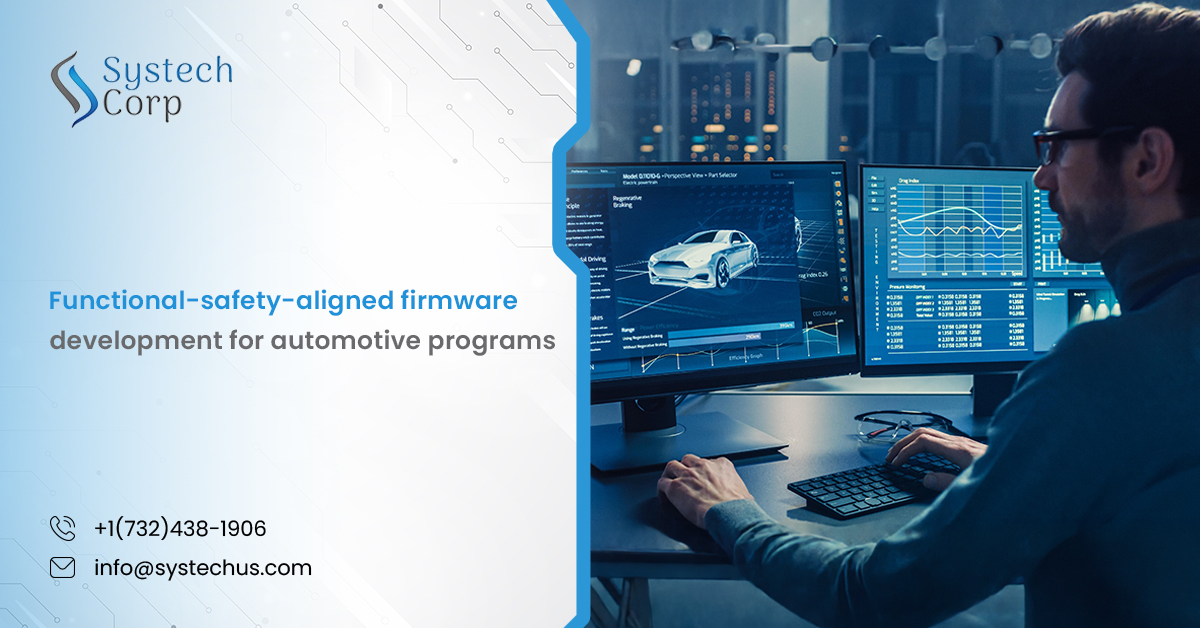
Functional-safety-aligned firmware development for automotive programs

If you are an Automotive Firmware Engineer, ECU development lead or Functional Safety Manager tasked with delivering scheduled safety critical software that is fully compliant, then this blog post was written specifically for you! Today there are over 150 ECUs in modern vehicles that contain hundreds of millions of lines of firmware code. One unchecked safety requirement can cause a product recall or a federal investigation, and could put your company out of business! We help the automotive engineering teams integrate functional safety into all firmware layers from the first development sprint so that you have ISO 26262 alignment, traceability, and production readiness without reducing the validation window at the end of the program!What Is Functional Safety Aligned Firmware Development?Functional safety-aligned firmware development is the practice of designing, coding, and validating automotive firmware in accordance with defined safety standards throughout the entire development lifecycle, not just at the final testing stage.What Does Functional Safety Firmware Development Involve?Firmware development for functional safety starts before anything is developed or coded; it is built on three activities that determine how to develop firmware.Hazard Analysis: This is performed to identify the potential failure modes within an ECU system; the responsible party determines ASIL ratings before firmware development begins.Safety Requirements: System-level safety goals must be translated into specific firmware requirements; these requirements must be fully traceable and serve as the basis for coding for all developers.Compliance with MISRA C: The function of each of these requirements is to ensure that the safety-critical firmware is written according to a defined coding standard that eliminates all undefined behaviour at the source level.The result of each of the above requirements will produce documentation relevant to the firmware development process. Hazard analysis is used to determine which functions require the highest degree of integrity to operate successfully. Safety requirements should provide developers a very specific set of specifications on which to base their coding. Compliance with MISRA C standards will provide assurance that no constructs exist in the code that create unpredictable behaviour; thus, the final product will be functionally safe to use, portable, and structurally safe.All three of these activities are the foundation upon which functional safety firmware development occurs, and these activities are what set it apart from traditional embedded software development. If any of the above activities are not completed, compliance cannot be demonstrated regardless of the rigor of the testing process.How Do ASIL Levels Define Firmware Development Requirements?ASIL is the risk classification system defined within ISO 26262. It determines how rigorously each firmware function must be developed, tested, and documented. Understanding which ASIL level applies to each ECU function is essential before any firmware architecture decision is made.A single ECU can contain firmware functions at multiple ASIL levels. When this occurs, freedom from interference must be enforced between higher and lower integrity components to prevent a lower-ASIL function from corrupting a higher-ASIL safety path. SystechCorp's automotive embedded software services address mixed-ASIL architectures by applying partitioning strategies, memory protection, and runtime monitoring that maintain integrity boundaries across all firmware components within the same ECU.ASIL A Systems: Cover non-critical functions such as interior lighting where any firmware failure causes only minimal safety consequences.ASIL D Systems: Cover braking, steering, and airbag firmware where any failure mode could directly result in fatalities.What Does ECU Firmware Development Cover Under ISO 26262?ECU firmware development under ISO 26262 goes well beyond writing functional code. It encompasses the full software unit design, implementation, integration, and verification cycle with safety evidence produced at every step.Three areas define what a complete ECU firmware development engagement covers in practice.Bootloader Development: Creates the secure initialisation layer that loads and verifies all safety-critical firmware modules correctly on startup.Diagnostic Services: Implements UDS protocol support to enable fault detection, logging, and remote firmware update capabilities in production.RTOS Integration: Configures real-time operating system task scheduling to meet deterministic timing requirements across all safety-critical ECU tasks.Each of these components carries direct safety implications. A bootloader that does not verify firmware integrity before loading it creates a path for corrupted or unauthorised software to execute in a safety-critical environment. Diagnostic services that do not log faults correctly prevent engineers from identifying and responding to safety violations in the field. RTOS configuration that does not enforce task deadlines introduces timing failures that can cause safety functions to respond too late to be effective.SystechCorp's ECU firmware development practice applies ISO 26262 Part 6 requirements across all three areas, producing software unit design specifications, code review evidence, and static analysis reports that support both internal engineering review and independent safety assessment.How Is Automotive Software Validation Applied to Safety-Critical Firmware?Automotive software validation is the process of confirming that firmware performs correctly on the target hardware under conditions representative of real vehicle operation. It is the final demonstration that the firmware does what the safety requirements specify, not just what the developer intended.Three validation activities are essential for any ISO 26262 compliant automotive programme.Requirements Traceability: Links every test case to a specific safety requirement ensuring complete coverage across the ECU firmware.Regression Validation: Re-runs all previously passing test cases after every firmware change to prevent new defects from appearing.Boundary Condition Testing: Validates firmware behaviour at the limits of defined input ranges where failure risk is consistently highest.Requirements traceability is particularly important for compliance submissions. OEMs and independent safety assessors require evidence that every safety requirement has at least one passing test case linked to it. Without this traceability matrix, the validation package is incomplete regardless of how many tests were run.SystechCorp builds traceability into every automotive software validation engagement from the start, using toolchains that produce bidirectional links between safety requirements, test specifications, test results, and code coverage data. This means the validation package is ready for assessor review without additional documentation effort at the end of the programme.What Should Automotive Teams Look for in a Functional Safety Firmware Partner?Selecting the right functional safety firmware partner determines whether ISO 26262 compliance is an engineering strength or a programme risk. Three criteria should define the evaluation.Safety Lifecycle Coverage: The partner must support all V-model phases from concept through system validation and production release.ASIL-Specific Experience: Verify the partner has delivered firmware for ASIL-B through ASIL-D programmes across production vehicle environments.Traceability Tooling: Confirm the partner uses tools that produce auditable safety artefacts acceptable to OEM and assessor review.A partner who only supports firmware coding but not hazard analysis, safety requirement definition, or validation leaves the most compliance-critical phases of the programme without specialist support. A partner without ASIL-D experience will not understand the documentation depth, independent review requirements, or freedom-from-interference obligations that the highest integrity programmes demand.SystechCorp meets all three criteria. The team supports automotive embedded software services across the full ISO 26262 safety lifecycle, with direct experience on ASIL-C and ASIL-D programmes covering powertrain, ADAS, and electric vehicle braking systems.How SystechCorp Supports Automotive Firmware Safety ProgrammesAs vehicles move toward software-defined architectures, autonomous driving stacks, and over-the-air firmware updates, the scope of functional safety firmware development will only grow. Every new ECU function, every new communication interface, and every new software update mechanism introduces safety obligations that must be managed through a structured ISO 26262 process.SystechCorp is positioned to support automotive engineering teams through this transition. The team brings hands-on experience across powertrain ECUs, ADAS platforms, and electric vehicle control systems, delivering ISO 26262 firmware development, ECU firmware development, and automotive software validation under a single, integrated engagement model. Compliance documentation is produced as a natural output of the engineering process, not assembled retrospectively before submission.Automotive firmware safety is not a phase that ends at type approval. It is an engineering discipline that carries forward through every update, every variant, and every new platform generation. SystechCorp helps automotive teams build that discipline into their organisation from day one. Every ASIL-D programme needs a dedicated partner who has truly been there before. Reach out to us at SystechCorp now.

S
Systech Corp
Apr 27, 2026 138 Reads

Functional-safety-aligned firmware development for automotive programs

If you are an Automotive Firmware Engineer, ECU development lead or Functional Safety Manager tasked with delivering scheduled safety critical software that is fully compliant, then this blog post was written specifically for you! Today there are over 150 ECUs in modern vehicles that contain hundreds of millions of lines of firmware code. One unchecked safety requirement can cause a product recall or a federal investigation, and could put your company out of business! We help the automotive engineering teams integrate functional safety into all firmware layers from the first development sprint so that you have ISO 26262 alignment, traceability, and production readiness without reducing the validation window at the end of the program!What Is Functional Safety Aligned Firmware Development?Functional safety-aligned firmware development is the practice of designing, coding, and validating automotive firmware in accordance with defined safety standards throughout the entire development lifecycle, not just at the final testing stage.What Does Functional Safety Firmware Development Involve?Firmware development for functional safety starts before anything is developed or coded; it is built on three activities that determine how to develop firmware.Hazard Analysis: This is performed to identify the potential failure modes within an ECU system; the responsible party determines ASIL ratings before firmware development begins.Safety Requirements: System-level safety goals must be translated into specific firmware requirements; these requirements must be fully traceable and serve as the basis for coding for all developers.Compliance with MISRA C: The function of each of these requirements is to ensure that the safety-critical firmware is written according to a defined coding standard that eliminates all undefined behaviour at the source level.The result of each of the above requirements will produce documentation relevant to the firmware development process. Hazard analysis is used to determine which functions require the highest degree of integrity to operate successfully. Safety requirements should provide developers a very specific set of specifications on which to base their coding. Compliance with MISRA C standards will provide assurance that no constructs exist in the code that create unpredictable behaviour; thus, the final product will be functionally safe to use, portable, and structurally safe.All three of these activities are the foundation upon which functional safety firmware development occurs, and these activities are what set it apart from traditional embedded software development. If any of the above activities are not completed, compliance cannot be demonstrated regardless of the rigor of the testing process.How Do ASIL Levels Define Firmware Development Requirements?ASIL is the risk classification system defined within ISO 26262. It determines how rigorously each firmware function must be developed, tested, and documented. Understanding which ASIL level applies to each ECU function is essential before any firmware architecture decision is made.A single ECU can contain firmware functions at multiple ASIL levels. When this occurs, freedom from interference must be enforced between higher and lower integrity components to prevent a lower-ASIL function from corrupting a higher-ASIL safety path. SystechCorp's automotive embedded software services address mixed-ASIL architectures by applying partitioning strategies, memory protection, and runtime monitoring that maintain integrity boundaries across all firmware components within the same ECU.ASIL A Systems: Cover non-critical functions such as interior lighting where any firmware failure causes only minimal safety consequences.ASIL D Systems: Cover braking, steering, and airbag firmware where any failure mode could directly result in fatalities.What Does ECU Firmware Development Cover Under ISO 26262?ECU firmware development under ISO 26262 goes well beyond writing functional code. It encompasses the full software unit design, implementation, integration, and verification cycle with safety evidence produced at every step.Three areas define what a complete ECU firmware development engagement covers in practice.Bootloader Development: Creates the secure initialisation layer that loads and verifies all safety-critical firmware modules correctly on startup.Diagnostic Services: Implements UDS protocol support to enable fault detection, logging, and remote firmware update capabilities in production.RTOS Integration: Configures real-time operating system task scheduling to meet deterministic timing requirements across all safety-critical ECU tasks.Each of these components carries direct safety implications. A bootloader that does not verify firmware integrity before loading it creates a path for corrupted or unauthorised software to execute in a safety-critical environment. Diagnostic services that do not log faults correctly prevent engineers from identifying and responding to safety violations in the field. RTOS configuration that does not enforce task deadlines introduces timing failures that can cause safety functions to respond too late to be effective.SystechCorp's ECU firmware development practice applies ISO 26262 Part 6 requirements across all three areas, producing software unit design specifications, code review evidence, and static analysis reports that support both internal engineering review and independent safety assessment.How Is Automotive Software Validation Applied to Safety-Critical Firmware?Automotive software validation is the process of confirming that firmware performs correctly on the target hardware under conditions representative of real vehicle operation. It is the final demonstration that the firmware does what the safety requirements specify, not just what the developer intended.Three validation activities are essential for any ISO 26262 compliant automotive programme. Requirements Traceability: Links every test case to a specific safety requirement ensuring complete coverage across the ECU firmware.Regression Validation: Re-runs all previously passing test cases after every firmware change to prevent new defects from appearing.Boundary Condition Testing: Validates firmware behaviour at the limits of defined input ranges where failure risk is consistently highest.Requirements traceability is particularly important for compliance submissions. OEMs and independent safety assessors require evidence that every safety requirement has at least one passing test case linked to it. Without this traceability matrix, the validation package is incomplete regardless of how many tests were run.SystechCorp builds traceability into every automotive software validation engagement from the start, using toolchains that produce bidirectional links between safety requirements, test specifications, test results, and code coverage data. This means the validation package is ready for assessor review without additional documentation effort at the end of the programme.What Should Automotive Teams Look for in a Functional Safety Firmware Partner?Selecting the right functional safety firmware partner determines whether ISO 26262 compliance is an engineering strength or a programme risk. Three criteria should define the evaluation.Safety Lifecycle Coverage: The partner must support all V-model phases from concept through system validation and production release.ASIL-Specific Experience: Verify the partner has delivered firmware for ASIL-B through ASIL-D programmes across production vehicle environments.Traceability Tooling: Confirm the partner uses tools that produce auditable safety artefacts acceptable to OEM and assessor review.A partner who only supports firmware coding but not hazard analysis, safety requirement definition, or validation leaves the most compliance-critical phases of the programme without specialist support. A partner without ASIL-D experience will not understand the documentation depth, independent review requirements, or freedom-from-interference obligations that the highest integrity programmes demand.SystechCorp meets all three criteria. The team supports automotive embedded software services across the full ISO 26262 safety lifecycle, with direct experience on ASIL-C and ASIL-D programmes covering powertrain, ADAS, and electric vehicle braking systems.How SystechCorp Supports Automotive Firmware Safety ProgrammesAs vehicles move toward software-defined architectures, autonomous driving stacks, and over-the-air firmware updates, the scope of functional safety firmware development will only grow. Every new ECU function, every new communication interface, and every new software update mechanism introduces safety obligations that must be managed through a structured ISO 26262 process.SystechCorp is positioned to support automotive engineering teams through this transition. The team brings hands-on experience across powertrain ECUs, ADAS platforms, and electric vehicle control systems, delivering ISO 26262 firmware development, ECU firmware development, and automotive software validation under a single, integrated engagement model. Compliance documentation is produced as a natural output of the engineering process, not assembled retrospectively before submission.Automotive firmware safety is not a phase that ends at type approval. It is an engineering discipline that carries forward through every update, every variant, and every new platform generation. SystechCorp helps automotive teams build that discipline into their organisation from day one. Every ASIL-D programme needs a dedicated partner who has truly been there before. Reach out to us at SystechCorp now.

S
Systech Corp
Apr 27, 2026 143 Reads

Beyond the Random Sample: How AI-Powered Quality Management Software is Revolutionizing Call Center QA

In the high-stakes world of customer service, the call center remains the frontline of brand reputation. For decades, supervisors have relied on traditional methods to ensure agents provide top-tier service. However, the manual approach to quality assurance is no longer sufficient in an era where customer expectations are at an all-time high.The introduction of AI-Powered Quality Management software has shifted the landscape. By automating the evaluation process and providing deeper insights into every interaction, this technology is moving call centers away from reactive "policing" and toward proactive, data-driven excellence.The Limitation of Traditional QA for Call CentersTo understand the value of AI, we must first look at the limitations of the traditional model. Historically, qa for call centers involved a supervisor or a dedicated QA specialist manually listening to a tiny percentage of recorded calls—usually between 1% and 2% of an agent’s total monthly volume.This "random sampling" method has several inherent flaws:Selection Bias: Managers might accidentally pick the best or worst calls, leading to an inaccurate representation of an agent’s overall performance.Lack of Context: With only 2% of calls monitored, critical trends and systemic issues often go unnoticed until they become major problems.Human Subjectivity: Different supervisors may score the same call differently based on personal interpretation, leading to friction between agents and management.The Shift to AI-Powered Quality Management SoftwareAI-Powered Quality Management software eliminates these gaps by using Natural Language Processing (NLP) and machine learning to analyze 100% of customer interactions—not just a symbolic sample. Whether it is a voice call, a chat session, or an email, the AI transcribes, parses, and scores the interaction based on pre-set compliance and quality parameters.1. Achieving 100% CoverageThe most immediate benefit of AI is the sheer scale of monitoring. When call center agent monitoring software is bolstered by AI, every single word spoken or typed is analyzed. This ensures that no compliance breach goes unnoticed and that every "unscripted" moment of excellence is caught and rewarded. This total visibility provides a holistic view of the call center’s health that was previously impossible to achieve.2. Objective and Consistent ScoringAI doesn't have "bad days," and it doesn't have personal biases. By applying a standardized set of criteria across every interaction, AI-Powered Quality Management software ensures that scoring is fair and objective. Agents are more likely to trust the QA process when they know the data is consistent and based on their entire body of work rather than a few cherry-picked calls.3. Sentiment Analysis and Emotional IntelligenceTraditional monitoring often focuses on "checkbox" compliance: Did the agent say the greeting? Did they verify the account? While compliance is important, it doesn't measure the emotional tone of the call.Modern qa for call centers leverages sentiment analysis to detect frustration, sarcasm, or satisfaction in a customer’s voice. It can also monitor the agent’s tone. If a customer is escalating, the software can flag the interaction in real-time, allowing supervisors to intervene before the situation deteriorates. This "emotional data" helps managers understand the why behind a customer’s experience, not just the what.Transforming Call Center Agent Monitoring Software into a Coaching ToolOne of the most significant impacts of AI is how it changes the relationship between agents and supervisors. In the past, QA feedback often felt like a "gotcha" moment. With AI-driven insights, the focus shifts to personalized growth.Targeted CoachingBecause the software analyzes thousands of hours of data, it can identify specific patterns in an agent's performance. For instance, it might notice that an agent excels at technical troubleshooting but struggles with empathy during billing disputes. Instead of generic training sessions, managers can provide highly targeted coaching that addresses the agent's unique needs.Real-Time EmpowermentAdvanced call center agent monitoring software now offers real-time agent assistance. During a live call, the AI can provide "next-best-action" suggestions or pull up relevant knowledge base articles based on the conversation. This reduces the pressure on agents and ensures they have the support they need to resolve issues on the first try.Improving Retention and Operational EfficiencyHigh turnover rates have long plagued the call center industry. Much of this is driven by the stress of being monitored and the frustration of receiving inconsistent feedback. By providing a fair, transparent, and supportive QA environment, AI-powered tools can significantly improve agent morale and retention.From an operational standpoint, the efficiency gains are undeniable. QA teams no longer need to spend hours manually searching for relevant calls to grade. Instead, they can focus their time on high-value activities, such as mentorship, strategy, and analyzing the high-level trends that the AI identifies.ConclusionThe transition from manual sampling to AI-Powered Quality Management software represents a fundamental shift in how customer service is managed. By providing 100% visibility, objective scoring, and deep sentiment analysis, AI empowers call centers to deliver a superior customer experience consistently.Effective qa for call centers is no longer just about catching mistakes; it is about uncovering opportunities for growth and providing agents with the tools they need to succeed. As AI continues to evolve, the organizations that embrace these intelligent monitoring solutions will be the ones that lead the way in customer satisfaction and operational excellence.

A
Allan Dermot
Apr 27, 2026 141 Reads

Freaky Font Generator: Create Unique and Fancy Text Styles Online

A Freaky Font Generator is one of the easiest ways to create stylish, eye-catching, and unique text online without installing any software. Whether you're designing a social media bio, creating gaming usernames, or adding flair to your content, a freaky font generator helps you transform plain text into creative typography instantly.These tools are popular among content creators, gamers, bloggers, and social media users who want their text to stand out. With just a few clicks, you can generate cool fonts, aesthetic symbols, and fancy lettering that you can copy and paste anywhere.In this guide, you’ll learn what a freaky font generator is, its benefits, features, how to use it, best practices, and answers to common questions.What is a Freaky Font Generator?A Freaky Font Generator is an online tool that converts normal text into stylish, decorative, and unusual font styles using Unicode characters. These fonts are not traditional fonts but special characters that look different across platforms.You type your text into the generator, and it instantly creates multiple fancy versions such as:Glitch textAesthetic fontsCursive stylesBold fancy textSmall capsBubble fontsWeird symbols textUpside-down textThese generated styles can be copied and pasted into:Instagram biosTikTok captionsTwitter postsYouTube descriptionsDiscord usernamesGaming profilesBlog headingsWhatsApp messagesBecause these fonts use Unicode characters, they work across most devices and platforms.Benefits of Using a Freaky Font GeneratorUsing a freaky font generator offers several advantages, especially for users who want creative text without design skills.1. Makes Your Text Stand OutStylish fonts grab attention instantly. Whether you're posting on social media or creating a username, fancy fonts help you look unique.2. No Design Skills RequiredYou don’t need Photoshop or graphic design tools. Just type your text and copy the style you like.3. Perfect for Social MediaFancy text improves engagement and visibility on platforms like Instagram, TikTok, and Facebook.4. Quick and Easy to UseMost generators work instantly. No signup, no downloads, and no waiting.5. Multiple Font StylesYou get dozens or even hundreds of different text styles in seconds.6. Free to UseMost freaky font generators are completely free online tools.7. Works on Mobile and DesktopYou can generate fancy fonts on any device including phones, tablets, and laptops.Features, Types, and Uses of Freaky Font GeneratorPopular Font Styles AvailableA good freaky font generator usually includes multiple font categories such as:1. Fancy Text Fonts𝓒𝓾𝓻𝓼𝓲𝓿𝓮𝓕𝓪𝓷𝓬𝔂𝐁𝐨𝐥𝐝𝕱𝖗𝖆𝖐𝖙𝖚𝖗2. Glitch & Weird FontsT̴e̴x̴t̴Z̷a̷l̷g̷o̷G̸l̸i̸t̸c̸h̸3. Aesthetic Fontsaestheticfancy textcool font4. Small Text Stylesᵗⁱⁿʸ ᵗᵉˣᵗˢᵐᵃˡˡ ᶠᵒⁿᵗ5. Symbol-Based Fonts★彡[Text]彡★♛ Fancy ♛✧ Cool Text ✧Common Uses of Freaky FontsPeople use freaky font generators for many purposes:Social media biosGaming usernamesYouTube channel namesInstagram captionsDiscord nicknamesTikTok usernamesBlog titlesWhatsApp statusBranding textCreative postsThese fonts help your text look stylish without needing graphic design.How to Use a Freaky Font GeneratorUsing a freaky font generator is extremely simple. Follow these steps:Step-by-Step GuideOpen a Freaky Font Generator websiteType your text into the input boxScroll through the generated font stylesChoose your favorite styleClick the copy buttonPaste it wherever you wantThat’s it. Your fancy text is ready.ExampleNormal Text:Freaky Font Generator Generated Styles:𝓕𝓻𝓮𝓪𝓴𝔂 𝓕𝓸𝓷𝓽 𝓖𝓮𝓷𝓮𝓻𝓪𝓽𝓸𝓻 𝐅𝐫𝐞𝐚𝐤𝐲 𝐅𝐨𝐧𝐭 𝐆𝐞𝐧𝐞𝐫𝐚𝐭𝐨𝐫 𝔉𝔯𝔢𝔞𝔨𝔶 𝔉𝔬𝔫𝔱 𝔊𝔢𝔫𝔢𝔯𝔞𝔱𝔬𝔯 Freaky Font Generator You can copy any of these and paste them into social media or messages.Best Practices and Tips for Using Freaky FontsUsing fancy fonts is fun, but using them correctly makes a big difference.1. Don’t Overuse Fancy FontsToo many fancy characters can make text hard to read. Use them for headings, names, or highlights.2. Test Across PlatformsSome fonts may not display correctly everywhere. Test on Instagram, TikTok, or Discord before using.3. Use for EmphasisUse freaky fonts for:TitlesUsernamesBiosHeadlinesHighlightsAvoid using them in long paragraphs.4. Combine with SymbolsYou can enhance fonts with symbols:Examples:✦ 𝓕𝓪𝓷𝓬𝔂 𝓣𝓮𝔁𝓽 ✦★ 𝐂𝐨𝐨𝐥 𝐅𝐨𝐧𝐭 ★♛ 𝔊𝔞𝔪𝔢𝔯 ♛5. Keep Readability in MindChoose fonts that are stylish but still readable.Good:𝐅𝐚𝐧𝐜𝐲 𝐓𝐞𝐱𝐭 Hard to read:T̴̛̛̛̍̓̿́͐̓̍́͌̒̍͐͗̽̈́̿͂̐́͋͑͋̾͐̐̈́̍̋̐̍̀͗͂͗̀͂̓̿̄̈́͑̀̿̿͐͌̋͛͛̓͗̔̍͊́͐́̈́̄̀̾̈́͋̾͊́͌̍͋̽̈́̈́͌͗̅̍̿̈́̓̈́͗̅̿̅̈́͌̈́̈́͑̀̈́͐̿̈́͌̍͋͗̿͋̈́͐̈́͗̈́̅̾̿͋̈́͛̈́̈́̀͛͗́̈́́́͗͗́͗͗͛́͛̈́͋͛͗́̈́̈́͗̈́́̈́̈́͛̈́͗͗́͋̈́́͗̈́͗͗́̈́͗́͛̈́͗̈́́͗̈́͗̈́́̈́́́̈́́͗̈́́͗́͗́̈́́͗́̈́́͗́͗́̈́́͗́͗́̈́́͗́͗́̈́́͗́͗́̈́́͗́͗́̈́́͗́͗́̈́́͗́͗́͘̕͘̕̕̕̚͘̕̚͘͘̚͘̕̕̕̚͘͘͝͝͝͝͝͝͠͠͝͝͝͝͠͠͝͝͝͝͝͠͝͝͝͝͝͝͝͝͝͝͝͝͝͝͝͝͝͝͝͝͝͝͝͝͝͝͝͝͝͝͝͝͝͝͝͝͝͝͝͝͝͝͝͝͝͝

L
Leticia Wallred
Apr 26, 2026 138 Reads

Best iOS Maintenance App in the UK: What to Look for Before You Download?

Most people searching for an iOS maintenance app are dealing with a phone that feels slower than it used to, or a storage warning that keeps appearing at the worst moment. The honest answer before you download anything: the App Store is full of apps in this category that look useful but are not. Some are fine. Some are overpriced subscription traps. A small number have genuine privacy problems. Knowing what to look for before you tap "get" saves you from all three.What can an iOS maintenance app do and what it cannot do?iOS is a closed operating system. Unlike Android, it does not let third-party apps scrub your system cache, touch core file directories, or run background processes without explicit permission. Apple built those restrictions deliberately.So when an app claims it will "speed up your iPhone" or "clear system junk," it is working within tight limits. What it can genuinely do is help you find and delete duplicate photos, identify large files sitting in your camera roll, organise contacts, and flag apps you have not opened in months. That is useful. It is just not magic.The apps that promise to remove viruses or repair system errors are the ones to avoid completely. iPhones do not get viruses in the traditional sense, and no third-party app has the system access to "repair" iOS. If you see that language in an app's description, close the App Store listing and move on.The privacy issue most UK users do not checkThis is the part that matters most and gets skipped most often. A Surfshark study found that all 10 of the most popular cleaning apps in the App Store share user data with third parties. That includes unique device identifiers, purchase history, location in some cases, and detailed logs of how you use the app.One researcher who tested two popular iPhone cleaner apps found that while no actual photos were transmitted, large amounts of device metadata were being sent to six or more analytics services. The apps passed Apple's App Store review. They just were not doing what most users assumed.For UK users, this matters particularly. Under UK GDPR, any app collecting personal data from UK residents must have a lawful basis for doing so and must disclose it clearly. The law does not stop an app from collecting data. It requires that the app tell you it is doing so, in plain language, before you agree.Before downloading any iOS maintenance app, UK users should go to the App Store listing and scroll to the "App Privacy" section. This is the section Apple requires every developer to complete honestly. Look at what data is collected and whether it is linked to your identity. If an app is collecting your contacts, location, and purchase history to clean your camera roll, that is worth questioning.What to check in the App Store before downloading?The App Store listing tells you more than most people read. Here is what to look at before you commit:App Privacy nutrition label. Scroll past the screenshots. Every app must show what it collects, what it uses that data for, and whether it shares it. A legitimate storage management app should have a minimal footprint here: photo access to find duplicates, contact access if it merges duplicates, nothing else.Review quality. Not the star rating. The content. Fake reviews tend to be short, recent, and generic. Look for reviews that describe a specific experience, mention what iOS version they are running, or report a specific problem. A pattern of one-line five-star reviews from accounts with no review history is a red flag.Developer identity. Tap the developer name and see what other apps they publish. A reputable developer tends to have a small, coherent catalogue. A developer publishing 30 near-identical "cleaner" apps under slightly different names is not a good sign.In-app purchase structure. A lot of apps in this category offer a free download and then immediately prompt a subscription before you can use any feature. Some are upfront about this. Others ask you to complete an "analysis" of your device and then reveal the paywall. Neither model is automatically bad, but you should know before you start what the actual cost is.Features worth paying for in a genuine iOS maintenance appIf you are looking at a paid iOS maintenance app UK option, these are the features that justify the cost:Duplicate photo detection. This is genuinely time-saving. iPhones accumulate duplicate photos from WhatsApp, screenshot sequences, Live Photos, and burst mode faster than most people realise. A good duplicate finder shows you side-by-side comparisons before deleting and does not auto-remove anything without your confirmation.Large file identification. Finding the 4 GB video buried in your camera roll from three years ago is something iOS Settings does not do conveniently. A maintenance app that surfaces your 20 largest files on one screen saves a lot of manual scrolling.Contact management. Merged duplicates, contacts with no number, and entries from years ago that you will never use. Not glamorous, but genuinely useful.Battery health monitoring. iOS 26 now includes a significantly overhauled Battery section in Settings, with per-app drain data and a more detailed health readout. A third-party app that only tells you your battery percentage is adding nothing. One that shows historical degradation patterns or compares your health against expected degradation curves for your model is more useful.What is not worth paying for: any app promising to "free up RAM," "boost speed," or "optimise performance." iOS manages memory itself and does it well. These buttons do nothing measurable.When are Apple's built-in tools genuinely enough?Before downloading anything, check what iOS already gives you. Go to Settings, then General, then iPhone Storage. You will see a breakdown by app, a list of large attachments, and suggestions from Apple for things you can offload. For most people with a storage problem, this screen alone solves it.iOS 26's expanded Battery section in Settings now shows which apps are draining your battery most, estimated runtimes, and charging pattern data. That is more honest than what most third-party battery apps can surface.The argument for a third-party iOS maintenance app UK download is really about convenience and interface. If you want everything in one place with a clearer visual layout, some apps do that well. But the underlying data Apple already gives you is solid.ConclusionThe best iOS maintenance app UK download is the one with a minimal data footprint, clear features, and no outlandish claims about what it can do to your system. Check the App Privacy label before anything else. If the permissions requested do not match the features being offered, that gap is worth taking seriously. Apple's own tools handle more than most people realise, and for a lot of users, the right answer is to spend five minutes in iPhone Storage settings before downloading anything at all.

N
Naskay Technologies Pvt Ltd